


I. Introduction
At the State University of New York at Old Westbury, the safety and well-being of our students, faculty, staff and visitors is always a primary concern. With the support of other surrounding municipal police departments, we have hundreds of people involved in keeping the campus safe and secure. However, a truly safe campus can only be achieved through the cooperation of all students, faculty, staff and visitors. We hope that you will read this notification carefully and use the information to help develop and maintain a safe environment for you and others on campus.
This report is filed as a requirement of the Federal Crime Awareness and Campus Security Act, (hereafter referred to as the Campus Safety Act/Clery Act) that was last amended in 2013. The purpose of this report is to provide our students, faculty and staff with campus safety information, including crime statistics and procedures to follow to report a crime. The report is prepared by the Chief of University Police and is electronically available on the Campus Safety Reports website and in hard copy at University Police Headquarters and other areas throughout the campus. Any questions regarding this report should be directed to the University Police Department, located in the Student Union parking lot or via telephone 516-876-3333, 516-628-5555 or extension 3333 from any campus phone.
SUNY Old Westbury is one of the 64 colleges and universities in the State University of New York system and was chartered in 1965 as an Arts and Science College located on the North Shore of Long Island, approximately 35 minutes from the Borough of Manhattan, New York City. The College covers 604 acres primarily in the confines of the Village of Old Westbury. Found on State Route 107, just north of both the Northern State Parkway and the Long Island Expressway (L.I.E.), the campus can be accessed from any of three gated entrances (one off Route 107 and the other two off the L.I.E. North Service Road).
II. General Security Information
In 2025, approximately 6,401 undergraduate and 655 graduate students were enrolled at the State University of New York at Old Westbury. The University has 14 residence halls, but only had 11 residence halls in use. For the Spring 2025 semester, there were 605 students in residence. For the Fall 2025 semester, there were 697 students in residence. The University’s facilities include a Student Union, Campus Center, Natural Science Building, and the Clark Center recreation venue. However, in 2021, the Clark Center was used to house a COVID vaccination site. In September 2012, a new 147,000 gross square foot LEED Certified energy efficient Academic Building was opened which houses a majority of the academic programs at the University. The University employs approximately 163 full-time faculty, 10 part-time faculty, and 250 adjunct faculty members. Presently, the University offers a total of 18 master’s degree programs, including but not limited to accounting, forensic accounting, taxation, liberal studies, mental health counseling, literacy education, childhood education, and 10 graduate programs and 5 advanced certificates in adolescence education.
Students, faculty and employees have access to academic, recreational and administrative facilities on campus during regular hours of operation. Access to the residence halls, however, is limited to students and their guests according to a guest procedure presented in the Guide to Campus Living. Access to the residence halls by college employees is on an ''as needed" basis. Access to the campus after 10:30 p.m. can only be made from the Route 107 “A Gate Entrance” which is manned by a University Police Officer, and University identification is necessary to gain entrance.
The public can attend cultural and recreational events on campus with their access limited only to facilities in which these events are held. To report any violations of this policy or to report suspicious persons, dial the University Police Department at 516-876-3333, 516-628-5555 or extension 3333 from any campus phone.
III. Crime Reporting
All members of the campus community are urged to report criminal incidents, emergencies and suspicious activity to the University Police Department at 516-876-3333, 516-628-5555 or extension 3333 from any campus phone. These numbers should be used for all fire, medical and police emergencies. All reports are classified, logged and responded to thoroughly.
Crimes in progress, and any other emergencies on campus, can be reported directly by any student, faculty member, employee or visitor to the University Police Department by dialing 516-876-3333, 516-628-5555 or extension 3333 from any campus phone. While on campus, calling the 911 emergency number may cause unnecessary delays in police response. The University Police can also be reached using emergency phones located at numerous locations on campus and in the front and rear of each of the Woodlands Residence Halls. Upon receipt of a call for assistance, University Police Officers are dispatched immediately to the site of the incident. The officers prepare and submit incident reports that are kept on file at University Police Headquarters. The University Police Department reports all criminal incidents on a monthly basis to the New York State Department of Criminal Justice Services, and yearly to the US Department of Education.
Members of the campus community can unofficially report criminal incidents to the following offices:
| Office | Phone number |
|---|---|
| Vice President for Student Affairs | 516-876-3175 |
| Dean of Students | 516-876-3067 |
| Student Health | 516-876-3250 |
| Residential Life | 516-876-3210 |
| Director of Athletics | 516-876-3241 |
| Counseling Center | 516-876-3053 |
| Director of Student Leadership and Involvement | 516-876-3109 |
| Environmental Health and Safety Officer | 516-876-3184 |
Please note that these offices allow victims and witnesses to report a crime on a voluntary, confidential basis. Reports of this nature are filed with University Police for informational purposes, but there will be no formal investigation of the incident unless the seriousness of the situation dictates and/or the department is requested to do so. Counselors at the college may inform members of the college community that crimes can be reported to the Division of Student Affairs or any competent authority at the University on a voluntary, confidential basis for inclusion in the University’s crime statistics report. It should be noted that professional or pastoral counselors are not considered a campus security authority when acting in those capacities dealing with the college community.
For staff and students living off campus, the following list of major area emergency numbers should be noted:
| Contact | Phone number |
|---|---|
| University Police | 516-876-3333 or 516-628-5555 |
| Old Westbury Village Police | 516-626-0200 |
| Mental Health Association of Nassau | 516-489-2322 |
| Nassau Coalition Against Domestic Violence | 516-542-0404 |
| Nassau County Department of Drug and Alcohol Addiction | 516-572-5355 |
| Parents Anonymous | 800-346-2211 |
| Nassau County Poison Control | 516-542-2323 |
| Nassau County Police Department 3rd Pct. | 516-573-6300 |
| Nassau County Police Department 2nd Pct. | 516-573-6200 |
IV. University Police Department
Campus safety and security is the responsibility of the University Police Department, which is comprised of the Chief of Police and nineteen other sworn police officers, including the Assistant Chief of Police, one investigator, four lieutenants and thirteen police officers with full police powers, along with three civilian police dispatchers. University Police Department Headquarters is located in the rear parking lot of the Student Union building and can be reached via telephone at 516-876-3333, 516-628-5555 or extension 3333 from any campus phone. Officers are armed and respond to all campus emergencies. The University Police Department is headed by Chief of Police Roberto Caban, who can be reached at 516-876-3333, or by e-mail at cabanr@oldwestbury.edu.
State University of New York Police Officers must meet the highest standards in New York State for law enforcement officers. The officers have passed a basic training program administered by the State University at the New York State Police Academy in Albany or a local regional police academy, and they undergo continuous training to upgrade their skills. All officers have been trained in emergency medical procedures and first aid. The officers engage in foot and in vehicular patrols on the campus, 24 hours a day, 365 days a year. These patrols include foot patrols of the residence halls as necessary.
The objective of the University Police Department is to ensure a safe environment for teaching, research and social endeavors and to protect the lives and property of the students, employees and visitors of SUNY Old Westbury. This objective is pursued within the framework of the State University Police Rules and Regulations and all local, state and federal laws. The investigation of crimes committed on the campus fall under the jurisdiction of the University Police Department, and to this end, the Department encourages the accurate and prompt reporting of all criminal incidents. The University Police Department also works closely with the New York State Police, the Nassau County Police Department and the bordering local municipal police departments to assist them with incidents that may occur off campus but involve students or employees of the University.
V. Relationships with Other Police Departments
The University Police Department, in cooperation with the Nassau County Police Department and other local municipal police departments, monitors criminal activity at off-campus events with university affiliation and frequented by students from our institution. At this time, SUNY Old Westbury has no off campus residence halls or college buildings that are owned or leased. Students involved in off-campus drug, alcohol or other criminal incidents may be referred to the Assistant Dean of Students for Community Standards and sanctions may be imposed if the student is found responsible for the offense.
If needed to appropriately respond to an emergency situation on campus, the Nassau County Police Department, the Village of Old Westbury Police Department, and/or Brookville Police Department may provide assistance to effectively deal with the emergency condition.
VI. Daily Crime Log
The University Police Department maintains a daily log of crimes or incidents that occur on campus and this log is available to the public at the University Police Department Headquarters located in the rear parking lot of the Student Union Building, and can be viewed by appointment. Please note that entries or updates are generally made on the day in question and within two business days after the event occurs. Some restrictions may be made to the release of this information in accordance with the protections afforded student information via the Buckley Amendment of the Family Educational Rights and Privacy Act of 1974 (FERPA). Incidents or situations deemed to pose a threat to the campus community are logged as soon as possible. While most events are logged, the Chief of University Police may determine that an incident should be classified as “confidential" to avoid jeopardizing a criminal investigation or the identity of certain victims.
The University Police Department also maintains an electronic crime log of all crimes reported to the Department which identifies by crime classification, case #, date, time, general location and disposition if available. This electronic crime log is also available to the public and can be viewed by appointment and requests for such access may be made during business hours Monday through Friday. Access to the electronic crime log may be restricted as noted above.
VII. Weapons on Campus
Firearms and other deadly weapons and dangerous instruments of any type are not permitted on campus. Intentional use, possession, or sale of firearms or other deadly weapons and dangerous instruments by anyone is strictly forbidden, and is a violation of state and federal law as well as a violation of the Code for Student Conduct. Violators are subject to University discipline, as well as criminal sanctions. The University President may authorize the possession of a weapon on campus for special or educational purposes. In support of the State University of New York guidelines and out of concern for the University community, no student shall possess or introduce to the campus community any deadly weapons or dangerous instruments including, but not limited to: knives, chukka sticks, pellet/BB/paint ball guns, firearms, and/or fireworks or other explosives.
VIII. Disciplinary Process
Any member of the college community may, and is urged to report, in writing, an alleged violation of the Code for Student Conduct or the Guide to Campus Living to University Police. The University Police Department sends copies of all complaints and subsequent investigation to the Dean of Students and/or the Assistant Dean of Students for Community Standards for determination of internal disciplinary action. The student(s) involved may become subject to a disciplinary investigation and a possible subsequent hearing. The Assistant Dean of Students for Community Standards will conduct a preliminary investigation providing the accused student with the opportunity to discuss the facts and circumstances which led to the report. The student may have the case heard by the Assistant Dean of Students for Community Standards in an administrative hearing, or by the Student Conduct Board. The Code for Student Conduct contains the complete explanation of the responsibilities and expectations of the University relative to the disciplinary process. It should be noted that the disciplinary process is separate from any arrest or prosecution for crimes committed on campus.
Upon written request, the University may disclose to the alleged victim of a crime of violence, or a non-forcible sex offense, the results of any disciplinary proceeding conducted by the University against a student who is the alleged perpetrator of the crime or offense. If the alleged victim is deceased as a result of the crime or offense, the University may provide the results of the disciplinary proceeding to the victim’s next of kin, if so requested.
Each incoming student to the University is given access to the "Virtual Orientation Folder" which includes Academic Support Services, Financial & Payment Information, Advisement & Course Registration, Other Student Resources, and Policies. The Code for Student Conduct may also be found on the University website in the Policies and Procedures section.
IX. Crime Prevention Activities
Members of the campus community are urged to secure their valuables and be aware at all times of their surroundings. To assist in this endeavor, the University Police and other campus services hold educational programs each semester on a variety of topics, including personal safety awareness and security, rape awareness/sexual assertiveness training, and anti-theft programs. Information on safety and security is provided on request to students and employees regularly via seminars, videos, crime alerts, posters, brochures and university and student newspapers, articles and notices transmitted via the university email service.
During orientation, programs are presented which address sexual assault, domestic violence, stalking, alcohol and drug use and fire safety, and other personal safety topics. Students are also informed of many personal safety services available on campus, which include campus escort, rape counseling, mental health services and emergency medical identification. Services available through the University Police Department throughout the year include motorist assistance, and training and instructional presentations when requested.
Special attention is paid to offering education and guidance relative to credit card utilization and the potential for abuse and/or identity theft. Students receive such counseling during orientation and the University has a stringent policy relative to registering credit card marketers and governing their exposure to the students and the manner in which they conduct business on campus.
In compliance with New York State Education Law section 6431 an Advisory Committee on Campus Safety exists that is comprised of a pre-established cross section of the campus community. This committee examines campus security issues to include security policies and procedures and makes recommendations for their improvement. The committee is co-chaired by the Vice President of Student Affairs and the Chief of University Police, and addresses issues of security education of the community, referring complaints to proper authorities, provisions for counseling of victims and any issues that may affect security on campus.
X. Facilities Management Department
The Facilities Management Department maintains campus buildings and grounds with a concern for safety and security. Campus facilities are inspected regularly with prompt repairs affecting safety and security, and the Facilities Management Department offers immediate response to reports of potential safety and security hazards, such as broken windows and locks. If you have concerns about the physical safety of campus buildings and grounds, please call the Physical Plant office Monday through Friday, 7:00 a.m. to 3:30 p.m., at ext. 3303. For emergencies that occur during non-business hours, call the University Police Department 516-876-3333, 516-628-5555 or extension 3333 from any campus phone. The Office of Environmental Health and Safety is located within the Facilities Management Office and issues relative to health and safety can be addressed by contacting the Director of Facilities, at 516-876-3184.
The University campus strives to be well lighted. The current lighting system utilizes high intensity sodium vapor lights throughout the campus roadways and parking areas and lighting surveys are regularly conducted to identify lighting problems on campus.
In addition, any student who chooses to report a potential safety issue on campus may utilize any of the major cell service providers or may choose to utilize any hard-wired campus telephone to identify the security issue to the appropriate entity on campus. Each residence hall room is wired for landline telephone operation, and if a student provides the telephone instrument, that telephone will have campus wide communication at no charge.
There are thirty-eight emergency telephones strategically located throughout the campus, which are connected directly to the University Police Department. Twenty of these emergency telephones are located in the vicinity of the Woodlands and Academic Village Residence Halls. The others are dispersed throughout the areas of the Student Union, Clark Center, Campus Center, roadways and pathways at the University.
XI. Security in the Residence Halls
The University’s Office of Residential Life is committed to providing a safe environment in the residence halls. Students are made aware of safety concerns as well as tips on prevention through brochures, pamphlets, floor meetings and presentations. While there are many safeguards in place for residential students, each student must do his/her part to ensure a safe and secure environment by adhering to the safety related policies and procedures.
The Residence Hall Directors are professional staff persons who live and work in the residence halls. A Residence Hall Director (RHD) supervises each of the residence halls. In the Woodlands residence halls, there are two Resident Assistants (RAs) on each floor with residents. In the Academic Village residence halls, there are two Resident Assistants per building. A Resident Assistant is a student who has been at SUNY Old Westbury for at least one semester and has received extensive training in many different aspects of residence hall living. All Residence Hall Directors and Resident Assistants undergo training in enforcing residence hall safety, security, and policies, as well as being aware of potential safety hazards and concerns. There is a Residence Hall Director on duty 24 hours a day, seven days a week, 365 days a year. Each Woodlands Residence Hall and the Academic Village have a Resident Assistant on duty from 8:00 pm to 8:00 am seven days per week during the academic year. Each Woodlands residence hall has a front reception area staffed by Resident Assistants 9:00 am-10:00 pm and Desk Attendant staff from 10:00 pm-2:00 am. The Academic Village has a central office located in Bolivar Hall staffed by Resident Assistants 9:00 am-10:00 pm.
Every residential hall student assigned to the Woodlands residence halls will be issued an electronic proximity card allowing access to the front and rear doors of the residence halls and a physical key to their assigned room. Every residential hall student assigned to the Academic Village Residence Halls will be issued a physical key allowing access to the front door of the residence halls and a physical key to their assigned room. Emergency telephones connected to the University Police Department are located at the street level of each residence hall. Although the campus is a safe place to live, there is always the potential for crime. Students are encouraged to be alert and aware of their environment and report any observation of suspicious activity. Residential hall students should not be lulled into a false sense of security. We all need to be aware of our environment and the possible consequences of our behavior.
XII. Title IX/Non-Discrimination Policy
SUNY Old Westbury is committed to maintaining an environment in which students, faculty and staff, as well as visitors, can work together free of all forms of harassment, exploitation and intimidation. It is the policy of the University to ensure equal treatment without discrimination or harassment on the basis of race, color, national origin, religion, creed, age, sex, sexual orientation, disability, gender identity or expression, familial status, pregnancy, predisposing genetic characteristics, military status, domestic violence victim status or criminal conviction. Harassment is one form of unlawful discrimination on the basis of the above protected categories. The University prohibits and will not tolerate any such discrimination or harassment, and will take steps to prevent discrimination and harassment, prevent the recurrence of discrimination and harassment, and to remedy its discriminatory effects on the victim(s) and others, if appropriate.
These policies apply to all members of the university community, including students, faculty, staff, volunteers, and third parties, and prohibit harassment, discrimination and retaliation with respect to employment, programs or activities at the University, whether engaged in by fellow employees, supervisors or managers, faculty members or students or by someone not directly connected to the University (e.g., an outside vendor, consultant or customer). Conduct prohibited by these policies is unacceptable in the workplace/classroom and in any university-related setting outside the workplace/classroom, such as during business (university) trips, business (university) meetings, and business (university)-related social events. These policies apply regardless of whether the parties are on campus, off campus or studying abroad.
Sexual Harassment in the Educational Setting – unwelcome conduct of a sexual nature. Sexual harassment can include unwelcome sexual advances, requests for sexual favors, and other verbal, nonverbal, or physical conduct of a sexual nature. Sexual harassment of a student denies or limits, on the basis of sex, the student’s ability to participate in or to receive benefits, services, or opportunities.
Sexual Harassment in the Employment Setting – unwelcome sexual advances, requests for sexual favors, or verbal or physical conduct of a sexual nature when any of the following occurs:
- Submission to such conduct is made a term or condition of an individual’s continued employment, promotion, or other condition of employment.
- Submission to or rejection of such conduct is used as a basis for employment decisions affecting an employee or job applicant.
- Such conduct is intended to interfere, or results in interference, with an employee’s work performance, or creates an intimidating, hostile, or offensive work environment.
Such conduct, whether committed by supervisors or non-supervisory personnel, is specifically prohibited. This includes, but is not limited to: repeated offensive and/or unwanted sexual flirtations, advances, or propositions; verbal abuse of a sexual nature; graphic or degrading verbal comments about an individual or his or her appearance; the unwanted display of sexually suggestive objects or pictures; or any offensive physical contact, such as patting, pinching, or brushing against another’s body.
These policies should not, and may not, be used as a basis for excluding or separating individuals of a particular gender, or any other protected characteristic, from participating in business, academic or work-related social activities or discussions in order to avoid allegations of harassment. The law and the policies of the University prohibit disparate treatment on the basis of sex or any other protected characteristic, with regard to terms, conditions, privileges and perquisites of employment/education. The prohibitions against harassment, discrimination and retaliation are intended to complement and further these policies, not to form the basis of an exception to them. The University has identified Mrs. Stephanie Benzaquen as a Title IX Coordinator. The Title IX Coordinator is responsible for examining instances of patterns of sexual harassment concerning recidivist offenders, geographic locations, groups of individuals, athletic teams or clubs and any other circumstances that have been identified as people, places and circumstances that are potential harassment threats to individuals on campus. The University directs all incidents of sexual harassment to the University Title IX Coordinator for examination and action regardless of who receives the complaint and all victims of such harassment are given the contact number for Mrs. Stephanie Benzaquen (516-876-2740).
Upon receiving a complaint of sexual harassment, the University Police Department will document such and investigate the complaint immediately explaining to the victim their rights and alternatives, along with providing the victim the contact information for the Title IX Coordinator. The Title IX Coordinator will be notified of the incident and the UPD will continue to communicate with the Title IX Coordinator as to the development of the investigation and will share pertinent information. Confidentiality shall be maintained whenever possible. However, absolute confidentiality is not always possible. Complaints are handled with discretion according to the principles of due process and fundamental fairness as follows:
- A person bringing a complaint in good faith will suffer no retaliation.
- The complaint should be in writing and sufficiently detailed.
- The person charged will be promptly notified and given an opportunity to respond.
- An individual will have up to 90 days after the alleged incident(s) to file a complaint. Complaints beyond the 90-day period will be evaluated on a case-by-case basis.
If a complaint is found to be valid, appropriate administrative action shall be taken, which may include, but is not limited to, counseling referrals, termination, demotion, reassignment, suspension, reprimand, or training, depending on the severity of the behavior.
The University prohibits retaliation against any individual who reports acts of discrimination or harassment, or participates in an investigation of such reports. Retaliation against an individual for reporting harassment or discrimination or for participating in an investigation of a claim of harassment or discrimination is a serious violation of this policy and, like harassment or discrimination itself, will be the subject of disciplinary action. Retaliation is an adverse action taken against an individual as a result of complaining about unlawful discrimination or harassment, exercising legal right, and/or participating in a complaint investigation as a third-party witness. Participants who experience retaliation should contact the Title IX Coordinator, Mrs. Stephanie Benzaquen, at 516-876-2740.
The University Police Department and other entities on campus have in the past and continue to receive training on issues dealing with domestic violence and sexual harassment. Additional information about the College’s non-discrimination/anti-harassment policy and procedures, as well as resources for support, may be found on the campus' Title IX website.
XIII. Sexual Crimes Information
Rape and sexual assault, such as sexual abuse and criminal sexual acts, constitute crimes that are prohibited by New York State law (see Section 130 of the New York State Penal Law and Section 4.3C of the Code for Student Conduct). Allegations of sexual assault or rape should be reported to the University Police Department at 516-876-3333, 516-628-5555 or extension 3333 from any campus phone, and allegations of sexual harassment on campus may be reported to the Title IX Coordinator at 516-876-2740. Victims of a sex crime may choose to report the offense and seek guidance from the Center for Counseling & Psychological Wellness Services prior to any other notifications. Upon request, the University will change a victim’s academic and/or living situation after an alleged sex offense if the options for the changes requested are reasonably available. The victim may request the assistance of the Center for Counseling & Psychological Wellness Services and the Student Health Center in this area.
Allegations of sexual assault or rape occurring on or off campus may be reported to the New York State Police, the Nassau County Police Department, Village of Old Westbury Police Department, Brookville Police Department or any other competent authority. The University Police Department will provide whatever assistance is needed in the notification of other Departments. Professional staff in the Division of Student Affairs, Counseling and Psychological Wellness, Student Health Services, and the Office of the Dean of Students are available for consultation relative to such incidents. Efforts will be made to ensure the confidentiality of all reports, except what is required and necessary to investigate the alleged offenses. University authorities may issue a Campus Crime Alert (Section XIX) to those areas of the University community affected by the crime. The issuance of this alert will depend on the particular circumstances of the crime.
Sexual Assault and the Law
New York State definitions for sex offenses differ slightly from those required for this report (i.e., the FBI Uniform Crime Reporting (UCR)/National Incident-Based Reporting System (NIBRS) definitions). The following is a list of sexual crimes and terms as defined in the State statutes:
CONSENT: Lack of consent results from: forcible compulsion; or incapacity to consent; or where the offense charged is sexual abuse or forcible touching, any circumstances, in addition to forcible compulsion or incapacity to consent, in which the victim does not expressly or impliedly acquiesce in the actor’s conduct. Where the offense charged is rape in the third degree, a criminal sexual act in the third degree, or forcible compulsion in circumstances under which, at the time of the act of intercourse, oral sexual conduct or anal sexual conduct, the victim clearly expressed that he or she did not consent to engage in such act, and a reasonable person in the actor’s situation would have understood such person’s words and acts as an expression of lack of consent to such act under all the circumstances. A person is incapable of consent when he or she is: less than 17 years old; or mentally disabled; or mentally incapacitated; or physically helpless; or committed to the care and custody of the state department of correctional services, a hospital, the office of children and family services and is in residential care, or the other person is a resident or inpatient of a residential facility operated by the office of mental health, the office for people with developmental disabilities, or the office of alcoholism and substance abuse services, and the actor is an employee, not married to such person, who knows or reasonably should know that such person is committed to the care and custody of such department or hospital.
DATING VIOLENCE: New York State does not specifically define “dating violence.” However, under New York Law, intimate relationships are covered by the definition of domestic violence when the act constitutes a crime listed elsewhere in this document and is committed by a person in an “intimate relationship” with the victim. See “Family or Household Member” for definition of “intimate relationship.”
DOMESTIC VIOLENCE: An act which would constitute a violation of the penal law, including, but not limited to acts constituting disorderly conduct, harassment, aggravated harassment, sexual misconduct, forcible touching, sexual abuse, stalking, criminal mischief, menacing, reckless endangerment, kidnapping, assault, attempted murder, criminal obstruction or breaching or blood circulation, or strangulation; and such acts have created a substantial risk of physical or emotional harm to a person or a person’s child. Such acts are alleged to have been committed by a family member. The victim can be anyone over the age of sixteen, any married person or any parent accompanied by his or her minor child or children in situations in which such person or such person’s child is a victim of the act.
FAMILY OR HOUSEHOLD MEMBER: Person’s related by consanguinity or affinity; Persons legally married to one another; Persons formerly married to one another regardless of whether they still reside in the same household; Persons who have a child in common regardless of whether such persons are married or have lived together at any time; Unrelated persons who are continually or at regular intervals living in the same household, or who have in the past continually or at regular intervals lived in the same household; Persons who are not related by consanguinity or affinity and who are or have been in an intimate relationship regardless of whether such persons have lived together at any time. Factors that may be considered in determining whether a relationship is an “intimate relationship” include, but are not limited to: the nature or type of relationship regardless of whether the relationship is sexual in nature; the frequency of interaction between the persons; and the duration of the relationship. Neither a casual acquaintance nor ordinary fraternization between two individuals in business or social contexts shall be deemed to constitute an “intimate relationship”; any other category of individuals deemed to be a victim of domestic violence as defined by the office of children and family services in regulation. Intimate relationship status shall be applied to teens, lesbian/gay/bisexual/transgender, and elderly individuals, current and formerly married and/or dating heterosexual individuals who were, or are in an intimate relationship.
PARENT: the natural/adoptive parent or any individual lawfully charged with a minor child’s care or custody.
SEXUAL ASSAULT: New York State does not specifically define sexual assault. However, according to the Federal Regulations, sexual assault includes offenses that meet the definitions of rape, fondling, incest, or statutory rape as used in the FBI’s UCR program.
SEX OFFENSES; LACK OF CONSENT: Whether or not specifically stated, it is an element of every offense defined in this article that the sexual act was committed without consent of the victim.
SEXUAL MISCONDUCT: When a person (1) engages in sexual intercourse with another person without such person’s consent; or (2) engages in oral sexual conduct or anal sexual conduct without such person’s consent; or (3) engages in sexual conduct with an animal or a dead human body.
RAPE IN THE THIRD DEGREE: When a person (1) engages in sexual intercourse with another person who is incapable of consent by reason of some factor other than being less than 17 years old; (2) being 21 years old or more, engages in sexual intercourse with another person less than 17 years old; or (3) engages in sexual intercourse with another person without such person's consent, where such lack of consent is by reason of some factor other than incapacity to consent.
RAPE IN THE SECOND DEGREE: When a person (1) being 18 years old or more, engages in sexual intercourse with another person less than 15 years old; or (2) engages in sexual intercourse with another person who is incapable of consent by reason of being mentally disabled or mentally incapacitated. It is an affirmative defense to the crime of rape in the second degree if the defendant was less than four years older than the victim at the time of the act.
RAPE IN THE FIRST DEGREE: When a person engages in sexual intercourse with another person (1) by forcible compulsion; or (2) who is incapable of consent by reason of being physically helpless; or (3) who is less than 11 years old; or (4) who is less than 13 years old and the actor is 18 years old or more.
CRIMINAL SEXUAL ACT IN THE THIRD DEGREE: When a person engages in oral or anal sexual conduct (1) with a person who is incapable of consent by reason of some factor other than being less than 17 years old; (2) being 21 years old or more, with a person less than 17 years old; (3) with another person without such persons consent where such lack of consent is by reason of some factor other than incapacity to consent.
CRIMINAL SEXUAL ACT IN THE SECOND DEGREE: When a person engages in oral or anal sexual conduct with another person (1) and is 18 years or more and the other person is less than 15 years old; or (2) who is incapable of consent by reason of being mentally disabled or mentally incapacitated. It is an affirmative defense that the defendant was less than four years older than the victim at the time of the act.
CRIMINAL SEXUAL ACT IN THE FIRST DEGREE: When a person engages in oral or anal sexual conduct with another person (1) by forcible compulsion; (2) who is incapable of consent by reason of being physically helpless; (3) who is less than 11 years old; or (4) who is less than 13 years old and the actor is 18 years old or more.
FORCIBLE TOUCHING: When a person intentionally, and for no legitimate purpose, forcibly touches the sexual or other intimate parts of another person for the purpose of degrading or abusing such person; or for the purpose of gratifying the actor’s sexual desire. It includes squeezing, grabbing, or pinching.
PERSISTENT SEXUAL ABUSE: When a person commits a crime of forcible touching, or second or third degree sexual abuse within the previous ten-year period, has been convicted two or more times, in separate criminal transactions for which a sentence was imposed on separate occasions of one of the above mentioned crimes or any offense defined in this article, of which the commission or attempted commissions thereof is a felony.
SEXUAL ABUSE IN THE THIRD DEGREE: When a person subjects another person to sexual contact without the latter’s consent. For any prosecution under this section, it is an affirmative defense that (1) such other person’s lack of consent was due solely to incapacity to consent by reason of being less than 17 years old; and (2) such other person was more than 14 years old and (3) the defendant was less than five years older than such other person.
SEXUAL ABUSE IN THE SECOND DEGREE: When a person subjects another person to sexual contact and when such other person is (1) incapable of consent by reason of some factor other than being less than 17 years old; or (2) less than 14 years old.
SEXUAL ABUSE IN THE FIRST DEGREE: When a person subjects another person to sexual contact (1) by forcible compulsion; (2) when the other person is incapable of consent by reason of being physically helpless; or (3) when the other person is less than 11 years old; or (4) when the other person is less than 13 years old.
AGGRAVATED SEXUAL ABUSE: For the purposes of this section, conduct performed for a valid medical purpose does not violate the provisions of this section.
AGGRAVATED SEXUAL ABUSE IN THE FOURTH DEGREE: When a person inserts a (1) foreign object in the vagina, urethra, penis or rectum of another person and the other person is incapable of consent by reason of some factor other than being less than 17 years old; or (2) finger in the vagina, urethra, penis, rectum or anus of another person causing physical injury to such person and such person is incapable of consent by reason of some factor other than being less than 17 years old.
AGGRAVATED SEXUAL ABUSE IN THE THIRD DEGREE: When a person inserts a foreign object in the vagina, urethra, penis, rectum or anus of another person (1)(a) by forcible compulsion; (b) when the other person is incapable of consent by reason of being physically helpless; or (c) when the other person is less than 11 years old; or (2) causing physical injury to such person and such person is incapable of consent by reason of being mentally disabled or mentally incapacitated.
AGGRAVATED SEXUAL ABUSE IN THE SECOND DEGREE: When a person inserts a finger in the vagina, urethra, penis, rectum or anus of another person causing physical injury to such person by (1) forcible compulsion; or (2) when the other person is incapable of consent by reason of being physically helpless; or (3) when the other person is less than 11 years old.
AGGRAVATED SEXUAL ABUSE IN THE FIRST DEGREE: When a person subjects another person to sexual contact: (1) By forcible compulsion; or (2) when the other person is incapable of consent by reason of being physically helpless; or (3) when the other person is less than eleven years old; or (4) when the other person is less than thirteen years old and the actor is twenty-one years old or older.
COURSE OF SEXUAL CONDUCT AGAINST A CHILD IN THE SECOND DEGREE: When over a period of time, not less than three months, a person: (1) engages in two or more acts of sexual conduct with a child less than 11 years old; or (2) being 18 years old or more engages in two or more acts of sexual conduct with a child less than 13 years old. A person may not be subsequently prosecuted for any other sexual offense involving the same victim unless the other charged offense occurred outside of the time period charged under this section.
COURSE OF SEXUAL CONDUCT AGAINST A CHILD IN THE FIRST DEGREE: When over a period of time, not less than three months in duration, a person: (1) engages in two or more acts of sexual conduct, or aggravated sexual contact with a child less than 11 years old; or (2) being 18 years old or more engages in two or more acts of sexual conduct which includes at least one act of sexual intercourse, oral sexual conduct, anal sexual conduct, or aggravated sexual contact with a child less than 13 years old.
FACILITATING A SEX OFFENSE WITH A CONTROLLED SUBSTANCE: A person is guilty of facilitating a sex offense with a controlled substance when he or she: (1) knowingly and unlawfully possesses a controlled substance or any preparation, compound, mixture or substance that requires a prescription to obtain and administers such substance or preparation, compound, mixture or substance that requires a prescription to obtain to another person without such person’s consent and with intent to commit against such person conduct constituting a felony defined in this article; and (2) commits or attempts to commit such conduct constituting a felony defined in this article.
INCEST IN THE THIRD DEGREE: A person is guilty of incest in the third degree when he or she marries or engages in sexual intercourse, oral sexual conduct or anal sexual conduct with a person whom he or she knows to be related to him or her, whether through marriage or not, as an ancestor, descendant, brother or sister of either the whole or the half blood, uncle, aunt, nephew or niece.
INCEST IN THE SECOND DEGREE: A person is guilty of incest in the second degree when he or she commits the crime of rape in the second degree, or criminal sexual act in the second degree, against a person whom he or she knows to be related to him or her, whether through marriage or not, as an ancestor, descendant, brother or sister of either the whole or the half blood, uncle, aunt, nephew or niece.
INCEST IN THE FIRST DEGREE: A person is guilty of incest in the first degree when he or she commits the crime of rape in the first degree, or criminal sexual act in the first degree, against a person whom he or she knows to be related to him or her, whether through marriage or not, as an ancestor, descendant, brother or sister of either the whole or half blood, uncle, aunt, nephew or niece.
STALKING IN THE FOURTH DEGREE: When a person intentionally, and for not legitimate purpose, engages in a course of conduct directed at a specific person, and knows or reasonably should know that such conduct (1) is likely to cause reasonable fear of material harm to the physical health, safety or property of such person, a member of such person’s immediate family or a third party with whom such person is acquainted; or (2) causes material harm to the mental or emotional health of such person, where such conduct consists of following, telephoning or initiating communication or contact with such person, a member of such person’s immediate family or a third party with whom such person is acquainted, and the actor was previously clearly informed to cease that conduct; or (3) is likely to cause such person to reasonably fear that his or her employment, business or career is threatened, where such conduct consists of appearing, telephoning or initiating communication or contact at such person’s place of employment or business, and the actor was previously clearly informed to cease that conduct.
STALKING IN THE THIRD DEGREE: When a person (1) commits the crime of stalking in the fourth degree against any person in three or more separate transactions, for which the actor has not been previously convicted; or (2) commits the crime of stalking in the fourth degree against any person, and has previously been convicted, within the preceding ten years of a specified predicate crime and the victim of such specified predicate crime is the victim, or an immediate family member of the victim, of the present offense; or (3) with an intent to harass, annoy or alarm a specific person, intentionally engages in a course of conduct directed at such person which is likely to cause such person to reasonably fear physical injury or serious physical injury, the commission of a sex offense against, or the kidnapping, unlawful imprisonment or death of such person or a member of such person’s immediate family; or (4) commits the crime or stalking in the fourth degree and has previously been convicted within the preceding ten years of stalking in the fourth degree.
STALKING IN THE SECOND DEGREE: When a person: (1) commits the crime of stalking in the third degree and in the course of and furtherance of the commission of such offense: (a) displays, or possesses and threatens the use of, a firearm, pistol, revolver, rifle, sword, billy, blackjack, bludgeon, plastic knuckles, metal knuckles, chuka stick, sand bag, sandclub, slingshot, slungshot, shirken, “Kung Fu Star,” dagger, dangerous knife, dirk, razor, stiletto, imitation pistol, dangerous instrument, deadly instrument or deadly weapons; or (b) displays what appears to be a pistol, revolver, rifle, shotgun, machine gun or other firearm; or (2) commits the crime of stalking in the third degree against any person, and has previously been convicted, within the preceding five years, of a specified predicate crime, and the victim of such specified predicate crime is the victim, or an immediate family member of the victim, of the present offense; or (3) commits the crime of stalking in the fourth degree and has previously been convicted of stalking in the third degree; or (4) being 21 years of age or older, repeatedly follows a person under the age of fourteen or engages in a course of conduct or repeatedly commits acts over a period of time intentionally placing or attempting to place such person who is under the age of fourteen in reasonable fear of physical injury, serious physical injury or death; or (5) commits the crime of stalking in the third degree, against ten or more persons, in ten or more separate transactions, for which the actor has not been previously convicted.
STALKING IN THE FIRST DEGREE: When a person commits the crime of stalking in the third degree or stalking in the second degree and, in the course and furtherance thereof, he or she intentionally or recklessly causes physical injury to the victim of such crime.
What to do if you are sexually or otherwise assaulted on campus
- Get to a safe place as soon as possible and seek support from university resources such as Health services and/or Counseling services.
- For the purpose of criminal prosecution, preserve all physical evidence including clothes, towels, bed linens and do not bathe or douche;
- Contact SUNY Old Westbury University Police Department immediately (516-876-3333, 516-628-5555 or extension 3333 from any campus phone, or use a Blue Light or other campus emergency phone).
Remember, assaults – sexual or otherwise – are crimes and as such are not the victims’ fault. Victims have the right to pursue adjudication of crimes that occur on the SUNY Old Westbury campus through criminal courts and/or through the University’s internal disciplinary process under the campus Code for Student Conduct. SUNY University Police are trained to assist with prosecution in both systems.
XIV. Violence Against Women Act (VAWA) Requirements
Campus policy encourages every member of the campus community to report a crime promptly to University Police if the victim wants to or is unable to report.
The University has programs to prevent domestic violence, dating violence, sexual assault, and stalking. When an incident of domestic violence, dating violence, sexual assault, or stalking is reported, the University will provide victims with written notice of available options, remedies, and services. If the accused individual is a student, the standard of evidence used in an institutional disciplinary hearing will be preponderance of the evidence.
The University has education programs to promote the awareness of rape, acquaintance rape, dating violence, domestic violence, sexual assault, and stalking. These education programs include primary prevention and awareness programs for all incoming students and new employees. These education programs will include: a statement that these crimes are prohibited at the University; definitions of consent, domestic violence, dating violence, sexual assault, and stalking in the University’s jurisdiction; safe and positive bystander intervention when there’s a risk of one of those incidents; information on risk reduction to recognize warning signs of abusive behavior and avoiding potential attacks; and information about the institutional disciplinary procedures.
Following a final determination of an institutional disciplinary procedure for cases of rape, acquaintance rape, dating violence, domestic violence, sexual assault, or stalking, sanctions and protective measures include but are not limited to: suspension, expulsion, education programs, community service, probation, and no-contact orders.
Survivors/victims of these crimes will be provided written information about evidence preservation, how and to whom to report these crimes, options about involvement of law enforcement and campus authorities, and assistance in notifying law enforcement if the victim chooses, as well as the option to decline to notify authorities. Victims will also be provided information in writing about rights and institutional responsibilities regarding no contact orders, orders of protection, or other available applicable options.
- Evidence preservation: In order to best preserve evidence, victims should avoid showering, washing, changing clothes, combing hair, drinking, eating, or doing anything to alter physical appearance until after a physical exam has been completed.
- Reporting: Victims should report to
- Title IX Coordinator, 516-876-2740; or
- University Police, 516-876-3333, 516-628-5555 or extension 3333 from any campus phone
- Notifying Law Enforcement: Victims have the right to notify law enforcement, and the campus can assist in notifying law enforcement if victims choose. Victims may also choose to decline to notify authorities.
The University’s disciplinary procedures will provide a fair, prompt, and impartial process from investigation to final result. The investigation and any hearing will be conducted by those who receive annual training on issues related to VAWA crimes, how to conduct an investigation, and a hearing process that protects victim safety and promotes accountability. Parties are entitled to the same opportunities to have an advisor of their choice present at any hearing and related meetings. There is no limit to the choice of an advisor; however, the parties are responsible for presenting evidence on their own behalf. Advisors may speak privately to their advisee during the proceeding, and cannot present evidence or cross-question witnesses. Parties will be informed simultaneously in writing of the outcome of the process, the availability of any appeal procedures, and when the results become final after any appeals. The disciplinary processes available for victims of domestic violence, dating violence, sexual assault, and stalking are student conduct disciplinary procedures, or disciplinary procedures pursuant to the appropriate collective bargaining agreement in the case of an employee. The standard of evidence in these cases is preponderance of the evidence. Following an allegation or report of one of these crimes, the institution may offer available protective measures such as a no-contact order; alteration of living, academic, and work situations.
The institution will maintain as confidential any accommodations or protective measures provided to the victims so long as it does not impair the ability to provide such measures. Personally identifiable information about victims will not be included in any publicly available record-keeping, including the reporting and disclosure of crime statistics.
The University will provide written notification to students and employees about existing and available counseling, health, mental health, victim advocacy, legal assistance, visa and immigration assistance, and other services available in community and on campus to victims of dating violence, domestic violence, sexual assault, and stalking. The University will also provide information about these services in writing to victims of domestic violence and dating violence.
The University will provide written notification to victims regarding rights and options, including: available and existing on- and off-campus services such as victim advocacy, counseling, health, mental health, legal assistance, visa and immigration assistance; available and applicable institutional disciplinary procedures, and an explanation of those procedures; confidentiality in protective measures and Clery reporting and disclosure; and reasonable and available options and assistance with changing academic, living, transportation, and working situations, regardless of whether the victim chooses to report the crime to law enforcement.
XV. Sexual Assault Information (Aid to Victims of Violence)
If you are a victim of sexual assault, immediately report the assault to the University Police Department at 516-876-3333, 516-628-5555 or extension 3333 from any campus phone, or 911 off campus. Police cannot investigate the incident as a crime unless you file a formal report. Reporting a crime to the police or to another campus office does not necessarily obligate you to follow through with criminal prosecution. A victim may choose to consult with other departments at the university or outside the university relative to the incident and seek their assistance.
The University Police Department is a member, with the surrounding local Police Departments and the Nassau County Police Department, of the Sexual Assault Nurse Examiner program (S.A.N.E.). The S.A.N.E. program governs the methodology for dealing with the victim of an investigation of sexual assault crimes during an investigation. The program has at its core, the utilization of specially trained nurses to deal with the victims of sexual assault and special provisions at Northwell Health where the program is based. The victims of sex-related crimes are treated with utmost respect, and caution is taken to secure all valuable evidence related to the crime. Guidance will be given to victims concerning the aftermath of the crime relative to tests for sexually transmitted diseases, pregnancy, etc.
The State University of New York at Old Westbury has programs to protect all members of the University community from sexual assault, including educational programs for prevention and prosecution of those that occur within the jurisdiction of the SUNY Old Westbury University Police Department. Training and educational programs relative to rape awareness and prevention of sexual assault are initiated and sponsored by professional staff in Counseling & Psychological Wellness Services and Student Health Services, and are available to all students and employees of the University. The Division of Student Affairs also compiles and produces a pamphlet entitled Sexual Assault Resource Guide for the OW Community that is available throughout various offices around campus. A comprehensive list of resources for survivors of sexual assault can also be found on the University website on the Title IX Resources page.
No matter when or where a sexual assault has occurred, support and referral resources are available to provide assistance. Contact one of the University offices previously mentioned in this report.
XVI. Criminal Prosecution and Campus Disciplinary Process for Sexual Assault Allegations
If a sexual assault takes place on campus and is reported to the University Police Department, both criminal and campus student conduct charges may be brought against the perpetrator. Criminal charges as defined in Section XIII will be adjudicated within the state or local judicial systems and the campus student conduct charges will be initiated by the Assistant Dean of Students for Community Standards. If the student is found responsible for a violation of the University’s sexual misconduct policy, the campus student conduct system sanctions may include expulsion from the residence halls, restriction from university sponsored events, suspension or expulsion from the University.
Pursuant to new legislation signed July 7, 2015 by Governor Cuomo, New York State has adopted a universal definition for affirmative consent which must be included in the codes for student conduct and incorporated into the disciplinary process at all higher education institutions. The definition may be found below, and additional requirements of the legislation may be found in Article 129B of the New York Education Law.
Affirmative consent is a knowing, voluntary, and mutual decision among all participants to engage in sexual activity. Consent can be given by words or actions, as long as those words or actions create clear permission regarding willingness to engage in the sexual activity. Silence or lack of resistance, in and of itself, does not demonstrate consent. The definition of consent does not vary based upon a participant's sex, sexual orientation, gender identity, or gender expression.
- Consent to any sexual act or prior consensual sexual activity between or with any party does not necessarily constitute consent to any other sexual act.
- Consent is required regardless of whether the person initiating the act is under the influence of drugs and/or alcohol.
- Consent may be initially given but withdrawn at any time.
- Consent cannot be given when a person is incapacitated, which occurs when an individual lacks the ability to knowingly choose to participate in sexual activity. Incapacitation may be caused by the lack of consciousness or being asleep, being involuntarily restrained, or if an individual otherwise cannot consent. Depending on the degree of intoxication, someone who is under the influence of alcohol, drugs, or other intoxicants may be incapacitated and therefore unable to consent.
- Consent cannot be given when it is the result of any coercion, intimidation, force, or threat of harm.
- When consent is withdrawn or can no longer be given, sexual activity must stop.
XVII. Sexual Offender Registration Act/Sexual Offender Community Notifications
The Sexual Offender Registration Act requires the Division of Criminal Justice Services (DCJS) to maintain a Sex Offender Registry. The Registry contains information on sex offenders classified according to their risk of re-offending as follows: low risk (level 1), moderate risk (level 2), and high risk (Level 3). The Act requires that DCJS also maintain a subdirectory of level 3 sex offenders. The DCJS Sex Offender Registry contains their Subdirectory of Level 3 sex offenders as well as other information regarding New York State’s Sex Offender Registry. Sex offender in New York are required to notify the Registry of any institution of higher education at which he or she is, or expect to be, whether for compensation or not, enrolled, attending or employed, and whether such sex offender resides or expects to reside in a facility operated by the institution. Changes in status at the institution of higher education must also be reported to the Registry no later than ten days after such change is available to the public.
Pursuant to an amendment to New York State’s Megan’s Law signed by Governor Pataki on March 11, 2002, New York State University Police Departments will receive notifications from the New York State Division of Criminal Services if a registered sexual offender enrolls at or is employed at our institution. Such information will be available at the University Police Department and may be documented on strategically located postings throughout the campus, and identified on email alerts to the University community. The Campus Sex Crimes Prevention Act (CSCPA) of 2000 is a federal law that provides for the tracking of convicted sex offenders enrolled or employed at institutions of higher education. It amends the Family Educational Rights and Privacy Act (FERPA) of 1974 to clarify that nothing in the Act can prohibit an educational institution from disclosing information provided to the institution concerning registered sex offenders.
XVIII. Hate/Bias Related Crimes
SUNY Old Westbury is required to annually report campus crime statistics to the U.S. Department of Education as required by Title 20 of the U.S. Code Section 1092(f). This information can be found on the U.S. Department of Education's website. It is a SUNY Old Westbury University Police mandate to protect all members of the University community by preventing and prosecuting bias or hate crimes that occur within the campus jurisdiction. Hate crimes, also called bias crimes or bias-related crimes, are a criminal activity motivated by the perpetrator's bias or attitude against an individual victim or group based on perceived or actual personal characteristics such as race, religion, ethnicity, national origin, gender, gender identity, sexual orientation, or disability. Hate based crimes have received renewed attention in recent years, particularly since the passage of the federal Hate/Bias Crime Reporting Act of 1990 and the New York Hate Crimes Act of 2000 (Penal Law Article 485).
Penalties of bias-related crimes are very serious and range from fines to imprisonment for lengthy periods, depending on the nature of the underlying criminal offense, the use of violence, or previous convictions of the offender. Perpetrators who are students will also be subject to campus disciplinary procedures where sanctions including expulsion are possible.
In addition to preventing and prosecuting hate/bias crimes, the University Police Department at SUNY Old Westbury, in concert with other entities on campus, also assist in addressing bias-related incidents that do not rise to the level of criminal activity. These activities, referred to as bias-related incidents and defined by the University as acts of bigotry, harassment, or intimidation directed at a member or group within the SUNY Old Westbury community based on national origin, ethnicity, race, age, religion, gender, sexual orientation, disability, veteran status, color, creed, or marital status, may be addressed through the SUNY Old Westbury Discrimination Complaint Procedure or the Code for Student Conduct. Bias incidents can be reported to the University Police as well as to the Affirmative Action Officer at ext. 3270. Hate/bias related crimes committed on campus are included in the compilation of campus crime statistics beginning on page twenty-two.
If you are a victim or witness to a hate/bias crime on campus, report the incident to University Police by calling the Department at 516-876-3333, 516-628-5555 or extension 3333 from any campus phone, using any emergency phones on campus, or stopping by University Police Headquarters in the Student Union parking lot. The University Police Department will investigate the incident and follow the appropriate adjudication process.
Victims of bias crimes or bias incidents can avail themselves of counseling and support from the campus by contacting the Center for Counseling and Psychological Wellness Services at 516-876-3053 or in person in the Wellness Wing, First Floor of the Campus Center I-wing.
XIX. Emergencies on Campus – Emergency Notification
All emergency conditions on campus are handled initially by the University Police Department and the Office of Facilities Management depending on the nature of the emergency condition. The University Police Department will evaluate the emergency condition and advise the University Administration as to the nature of the emergency and the possible need for assistance from outside the University. The University Police Department in conjunction with the University Administration will determine if the emergency condition is an immediate threat to the safety of the university community and warrants immediate notification to students and staff at the university. If you are a witness to an emergency or potential for an emergency condition, notify the University Police Department at 516-876-3333, 516-628-5555 or extension 3333 from any campus phone or by utilization of any emergency call box on campus.
MASS NOTIFICATION SYSTEM - In the case of an emergency at the University, notification to the student body and/or faculty and staff will be made through one or more of our mass notification systems, as follows:
The Everbridge New York Alert System, which utilizes a variety of notification avenues to notify students, faculty and staff as to the nature of the emergency, action to be taken and operational status of the University. The Everbridge New York Alert system is an All-Hazard Alert and Notification system that the university, along with other SUNY institutions, utilizes to notify students, faculty and staff at contact points supplied by the university community member. These emergencies may include bomb threats, fire, hazardous materials, medical emergencies, personal safety, suspicious package, severe weather conditions or mechanical related issues. The system utilizes hard wire, fax, cell phone, text and voicemail to make notification to those enrolled in the system. The University highly recommends that all students and staff enroll in the Everbridge New York Alert System and will make notifications to the community as to the process by which that community member may be included in this system. Standard notification procedures may be altered if the emergency response authorities determine that it would compromise efforts to assist a victim, or efforts to contain, respond to or otherwise mitigate the emergency.
The University also has in place a dual siren emergency warning system which will blast warning tones and provide notification and instructions to the community as to the nature of an emergency and provide information as to an immediate community response.
The University also has in place a mass notification system, RAVE, that utilizes the e-mail addresses of the University community to announce emergency conditions and a variety of other notifications dealing with campus safety and other important issues pertinent to the operation of the University.
All emergency warning systems are tested at the minimum of twice each year by the University Police Department in conjunction with other University administrators and assessments are made during these tests that evaluate the performance of the emergency notification systems.
UNIVERSITY EMERGENCY RESPONSE PLAN - All members of the University community should familiarize themselves with the emergency response and evacuation procedures in the University Emergency Response Plan, which is located on the SUNY Old Westbury web site and can be accessed as follows: Go to the University website at www.oldwestbury.edu and click on University Police. Click on Safety and Services, and then on Emergency Preparedness. It is important that all students and staff review this plan and understand its implications.
TIMELY WARNINGS POLICY – CAMPUS CRIME ALERT - In the event that a crime or a series of crimes or events occur on campus, or in the immediate vicinity of the University, that may not pose an immediate threat to the University community and notification of the University community is thought to be prudent, a Campus Crime Alert may be initiated by the Chief or Deputy Chief of Police. The Campus Crime Alert will be prepared by the University Police Department and will be distributed to the community as a whole or to a specific area of the University determined to be at risk. The alert will detail the nature of the crime, identify subjects if available and provide guidance as to safety precautions that should be considered. The Crime Alert will be distributed as soon as possible after the event and shall be distributed as follows:
- Campus-wide email, phone and/or SMS text to students, faculty and staff; or
- The campus website (with Police/Safety link); or
- The student newspaper, the Catalyst; or
- Postings at main entrance doors to academic and residence hall buildings
XX. Missing Persons
Resident students are encouraged to identify a confidential missing persons contact in addition to an emergency contact person. Within 24 hours, University personnel will contact the missing persons contact in the event the student is determined to be missing. This process of identifying this confidential contact will be handled by the Division of Student Affairs at or about move-in times in the residence halls. The information regarding the registered contact for missing person notification will be kept confidential and stored separately from the general emergency contact designated by the student; the information will be accessible only to authorized campus officials; and it may not be disclosed except to law enforcement personnel in furtherance of a missing person investigation. It should be noted that, regardless of whether a student has registered a confidential contact person, the University Police Department and local municipal police departments will be notified of the missing person and take appropriate action. If the student reported missing is an off-campus student, the appropriate law enforcement agency will be contacted. Investigative and crime reporting procedures will be coordinated by that agency or the agency in the jurisdiction where the student was last reported. University Police will assist as appropriate.
- Missing resident students should be reported directly to the University Police Department but may be reported to a representative from the Division of Student Affairs, Dean of Students, Director of Residential Life or designee or the Center for Counseling and Psychological Wellness Services.
- Do not wait to make a missing person notification if you believe that a student is missing since the University Police Department will immediately begin investigating the incident in order to reach a quick resolution.
- Within 24 hours if the incident is not resolved:
- The University Police Department will provide missing person information to local police departments pursuant to Memoranda of Understanding which exist with the Nassau County Police Department and the Village of Old Westbury Police Department as required by Federal law.
- Contact the student’s designated contact person if provided.
- Contact a custodial parent or guardian of any student under 18 years of age and not emancipated.
- The University Police Department will immediately begin an investigation and if after a reasonable period of time (not more than 24 hours) the student has not been located, the University Police Department will proceed with the required notifications as mandated by law. The sooner the investigation begins concerning a missing person, the better the chances of locating the missing person.
Section 355 of the NYS Education Law states "Missing student" means any student of an institution subject to the provisions of this subdivision, who resides in a facility owned or operated by such institution and who is reported to such institution as missing from his or her residence.
XXI. Clery Offense Definitions
The definitions for murder, robbery, aggravated assault, burglary, motor vehicle theft, weapon law violations, drug abuse violations and liquor law violations are excerpted from the Uniform Crime Reporting Handbook. The definitions of the sex offense categories (Rape, Fondling, Incest, and Statutory Rape) are excerpted from the national incident-based reporting user manual of the Uniform Crime Reporting Program.
Robbery The taking or attempting to take anything of value from the care, custody, or control of a person or persons by force or threat of force or violence and/or by putting the victim in fear.
Aggravated Assault An unlawful attack by one person upon another and inflicting severe or aggravated bodily injury. This type of assault is usually accompanied by the use of a weapon or by means likely to produce death or great bodily harm. (It is not necessary that injury result from an aggravated assault when a gun, knife, or other weapon is used which could and probably would result in serious personal injury if the crime were successfully completed.)
Burglary The unlawful entry of a structure to commit a crime. For reporting purposes, this definition includes: unlawful entry both forcible and unlawful with intent to commit a felony or theft, breaking and entering with intent to commit a larceny, housebreaking, safecracking, and all attempts to commit any of the aforementioned.
Motor Vehicle Theft The theft or attempted theft of a motor vehicle. (Classify as motor vehicle theft all cases where automobiles are taken by persons not having lawful access even though the vehicles are later abandoned, including joyriding.)
Weapon Law Violations The violation of NYS laws or local ordinances dealing with weapon offenses, regulatory in nature, such as manufacture, sale, or possession of deadly weapons; carrying deadly weapons, concealed or openly; furnishing deadly weapons to minors; aliens possessing deadly weapons; and all attempts to commit any of the aforementioned.
Drug Abuse Violations The violation of NYS laws or local ordinances relating to the unlawful possession, sale, use, growing, manufacturing, and making of narcotic drugs. The relevant substances include: opium or cocaine and their derivatives (morphine, heroin, codeine); marijuana; synthetic narcotics (Demerol, methadone); and dangerous non-narcotic drugs (barbiturates, Benzedrine).
Liquor Law Violations The violation of NYS laws or local ordinances prohibiting the manufacture, sale, transporting, furnishing or possessing intoxicating liquor; maintaining unlawful drinking places; bootlegging; operating a still; furnishing liquor to a minor or intemperate person; using a vehicle for illegal transportation of liquor; drinking on a train or public conveyance; and all attempts to commit any of the aforementioned. (Drunkenness and driving under the influence is not included in this definition.)
Arson Any willful or malicious burning or attempt to burn, with or without intent to defraud, a dwelling house, public building, motor vehicle or aircraft, personal property of another.
Hazing Any intentional, knowing, or reckless act committed by a person (whether individually or in concert with other persons) against another person or persons regardless of the willingness of such other person or persons to participate that is committed in the course of an initiation into, an affiliation with, or the maintenance of membership in, a student organization; and causes or creates a risk, above the reasonable risk encountered in the course of participation in the institution of higher education or the organization (such as the physical preparation necessary for participation in an athletic team), of physical or psychological injury including— whipping, beating, striking, electronic shocking, placing of a harmful substance on someone’s body, or similar activity; causing, coercing, or otherwise inducing sleep deprivation, exposure to the elements, confinement in a small space, extreme calisthenics, or other similar activity; causing, coercing, or otherwise inducing another person to consume food, liquid, alcohol, drugs, or other substances; causing, coercing, or otherwise inducing another person to perform sexual acts; any activity that places another person in reasonable fear of bodily harm through the use of threatening words or conduct; any activity against another person that includes a criminal violation of local, State, Tribal, or Federal law; and any activity that induces, causes, or requires another person to perform a duty or task that involves a criminal violation of local, State, Tribal, or Federal law.
Criminal Homicide- Manslaughter by Negligence The killing of another person through gross negligence.
Criminal Homicide- Murder and Non-Negligent Manslaughter The willful (non-negligent) killing of one human being by another.
Sex Offenses Any sexual act directed against another person, without the consent of the victim, including instances where the victim is incapable of giving consent. The reportable Clery categories are defined below:
- Rape The penetration, no matter how slight, of the vagina or anus with any body part or object, or oral penetration by a sex organ of another person, without the consent of the victim. This definition includes any gender of victim or perpetrator.
- Fondling The touching of the private body parts of another person for the purpose of sexual gratification, without the consent of the victim, including instances where the victim is incapable of giving consent because of his/her age or because of his/her temporary or permanent mental incapacity.
- Incest Sexual intercourse between persons who are related to each other within the degrees wherein marriage is prohibited by law.
- Statutory Rape Sexual intercourse with a person who is under the statutory age of consent.
Hate/Bias Crimes A crime reported to local police agencies or to a campus security authority that manifests evidence that the victim was intentionally selected because of the perpetrator’s bias against the victim. For the purposes of this section, the categories of bias include the victim’s actual or perceived race, religion, gender, gender identity, sexual orientation, ethnicity, national origin, and disability.
The crime statistics contained herein satisfy reporting requirements for colleges and universities in the categories of Domestic Violence, Dating Violence and Stalking pursuant to the requirements of the Violence Against Women Reauthorization Act (VAWA) signed into law in March 2013. The following are definitions relative to those categories:
Domestic Violence A felony or misdemeanor crime of violence committed by a current or former spouse or intimate partner of the victim, a person with whom the victim shares a child in common, a person who is cohabitating with, or has cohabitated with, the victim as a spouse or intimate partner, a person similarly situated to a spouse of the victim under the domestic or family violence laws of the jurisdiction in which the crime of violence occurred, or any other person against an adult or youth victim who is protected from that person’s acts under the domestic or family violence laws of the jurisdiction in which the crime of violence occurred.
Dating Violence Violence committed by a person who is or has been in a social relationship of a romantic or intimate nature with the victim. The existence of such a relationship shall be determined based on the reporting party’s statement and with consideration of the length of the relationship, the type of relationship, and the frequency of interaction between the persons involved in the relationship. Dating violence includes, but is not limited to, sexual or physical abuse or the threat of such abuse.
Stalking A course of conduct directed at a specific person that would cause a reasonable person to fear for the person’s safety or the safety of others; or suffer substantial emotional distress. Course of conduct means two or more acts, including, but not limited to, acts in which the stalker directly, indirectly, or through third parties, by any action, method, device, or means, follows, monitors, observes, surveils, threatens, or communicates to or about a person, or interferes with a person’s property. Reasonable person means a reasonable person under similar circumstances and with similar identities to the victim. Substantial emotional distress means significant mental suffering or anguish that may, but does not necessarily, require medical or other professional treatment or counseling.
XXII. Campus Crime Statistics
In accordance with recent updates to the Campus Safety Act/Clery Act the following data is presented to review crime activity both on campus and on streets and properties adjacent to campus property. A map, which defines these areas, is available through the University Police Department and is included in this report. Reported on-campus offenses include all offenses reported on campus property and in campus buildings. A specific breakdown of offenses occurring in University owned residence halls appears under "residence halls" or "other student residences".
Two other categories are presented in this chart: "non-campus buildings or property" and "public property". The first category, non-campus buildings or property includes properties owned by student organizations officially recognized by the institution and those owned by the University outside the campus boundaries. SUNY Old Westbury does not at this time have any such buildings. The second category, public property, includes thoroughfares, streets, sidewalks and parking facilities immediately adjacent to the campus. The offenses presented for this report include those reported by the Second and Third Precincts of the Nassau County Police Departments, along with the Village of Old Westbury Police Department and the Brookville Police Department.
This report on campus crime statistics also includes arrests and disciplinary referrals made to campus authorities for alcohol, drugs and weapons possession. As defined by the Campus Safety Act/Clery Act, a disciplinary referral is an instance when a student is formally reported in writing to a university officer for possible sanction.
As required by the Campus Safety Act/Clery Act, the University is required to report hate crimes in this report. For this report, a hate crime occurs when a person is victimized intentionally because of his or her actual or perceived race, gender, gender identity, religion, sexual orientation, ethnicity, national origin, or disability.
The crimes presented here are based on reports filed with the following offices: Chief of University Police, Vice President for Student Affairs, Dean of Students, Director of Residence Life, Director of Student Health Center and Director of Athletics along with other University entities that may have Clery reporting designation on campus. Formal requests for crime statistics for areas defined as "public property" and "non-campus buildings and property” were made with the Nassau County Police Department, Village of Old Westbury Police Department and the Brookville Police Department.
The University Police Department submits monthly crime reports to the New York State Department of Criminal Justice Services. This data is then submitted to the United States Department of Justice for the Uniform Crime Reports. The following statistics reflect the number of on-campus crimes and crimes committed in areas surrounding the campus that have been reported to University officials in accordance with the responsibilities of the final revision of the (Federal) Crime Awareness and Campus Safety Act (Campus Safety Act/Clery Act).
IMPORTANT NOTES
The statistics located in the following charts include anonymous reports made to campus offices described in this report. They represent incidents believed to be made in good faith, but for which no verification has been established. Further, those categories represent all incidents that occurred on campus, including those also listed as having occurred “In residence halls.” These categories represent duplication and are not cumulative.
It should also be noted that as of 2009, the FBI has reconsidered and has redefined its classification of burglary to be the unlawful entry (trespass) both forcible and unlawful within a structure and that the entry was made to commit a felony or theft. If the intent was not to commit such crimes, or if the intent cannot be determined, the proper classification is larceny.
| Category | Venue | 2023 | 2024 | 2025 |
|---|---|---|---|---|
| Murder/Non-Negligent Manslaughter | On campus | 0 | 0 | 0 |
| In residence halls | 0 | 0 | 0 | |
| In or on a non-campus building/property | 0 | 0 | 0 | |
| On public property | 0 | 0 | 0 | |
| Total | 0 | 0 | 0 | |
| Negligent Manslaughter | On campus | 0 | 0 | 0 |
| In residence halls | 0 | 0 | 0 | |
| In or on a non-campus building/property | 0 | 0 | 0 | |
| On public property | 0 | 0 | 0 | |
| Total | 0 | 0 | 0 | |
| Sex Offenses - Rape | On campus | 3 | 2 | 4 |
| In residence halls | 2 | 2 | 4 | |
| In or on a non-campus building/property | 0 | 0 | 0 | |
| On public property | 0 | 0 | 0 | |
| Total | 3 | 2 | 4 | |
| Sex Offenses - Fondling | On campus | 1 | 1 | 1 |
| In residence halls | 1 | 1 | 1 | |
| In or on a non-campus building/property | 0 | 0 | 0 | |
| On public property | 0 | 0 | 0 | |
| Total | 1 | 1 | 1 | |
| Sex Offenses - Incest | On campus | 0 | 0 | 0 |
| In residence halls | 0 | 0 | 0 | |
| In or on a non-campus building/property | 0 | 0 | 0 | |
| On public property | 0 | 0 | 0 | |
| Total | 0 | 0 | 0 | |
| Sex Offenses - Statutory Rape | On campus | 0 | 0 | 0 |
| In residence halls | 0 | 0 | 0 | |
| In or on a non-campus building/property | 0 | 0 | 0 | |
| On public property | 0 | 0 | 0 | |
| Total | 0 | 0 | 0 | |
| Robbery | On campus | 0 | 0 | 2 |
| In residence halls | 0 | 0 | 1 | |
| In or on a non-campus building/property | 0 | 0 | 0 | |
| On public property | 0 | 0 | 0 | |
| Total | 0 | 0 | 2 | |
| Hazing | On campus | N/A | N/A | 0 |
| In residence halls | N/A | N/A | 0 | |
| In or on a non-campus building/property | N/A | N/A | 0 | |
| On public property | N/A | N/A | 0 | |
| Total | N/A | N/A | 0 | |
| Aggravated Assault | On campus | 0 | 0 | 1 |
| In residence halls | 0 | 0 | 0 | |
| In or on a non-campus building/property | 0 | 0 | 0 | |
| On public property | 0 | 0 | 0 | |
| Total | 0 | 0 | 1 | |
| Burglary | On campus | 5 | 7 | 9 |
| In residence halls | 4 | 7 | 7 | |
| In or on a non-campus building/property | 0 | 0 | 0 | |
| On public property | 0 | 0 | 0 | |
| Total | 5 | 7 | 9 | |
| Arson | On campus | 0 | 0 | 0 |
| In residence halls | 0 | 0 | 0 | |
| In or on a non-campus building/property | 0 | 0 | 0 | |
| On public property | 0 | 0 | 0 | |
| Total | 0 | 0 | 0 | |
| Motor Vehicle Theft | On campus | 1 | 0 | 0 |
| In residence halls | 0 | 0 | 0 | |
| In or on a non-campus building/property | 0 | 0 | 0 | |
| On public property | 0 | 0 | 0 | |
| Total | 1 | 0 | 0 | |
| Liquor Law Arrest | On campus | 0 | 0 | 0 |
| In residence halls | 0 | 0 | 0 | |
| In or on a non-campus building/property | 0 | 0 | 0 | |
| On public property | 0 | 0 | 0 | |
| Total | 0 | 0 | 0 | |
| Liquor Law Violation Disciplinary Referrals | On campus | 4 | 4 | 1 |
| In residence halls | 3 | 4 | 1 | |
| In or on a non-campus building/property | 0 | 0 | 0 | |
| On public property | 0 | 0 | 0 | |
| Total | 4 | 4 | 1 | |
| Drug Related Arrests | On campus | 0 | 0 | 0 |
| In residence halls | 0 | 0 | 0 | |
| In or on a non-campus building/property | 0 | 0 | 0 | |
| On public property | 0 | 0 | 0 | |
| Total | 0 | 0 | 0 | |
| Drug Related Violations Disciplinary Referrals | On campus | 9 | 6 | 4 |
| In residence halls | 5 | 4 | 4 | |
| In or on a non-campus building/property | 0 | 0 | 0 | |
| On public property | 0 | 0 | 0 | |
| Total | 9 | 6 | 4 | |
| Weapons Possession Arrest | On campus | 1 | 0 | 0 |
| In residence halls | 1 | 0 | 0 | |
| In or on a non-campus building/property | 0 | 0 | 0 | |
| On public property | 0 | 0 | 0 | |
| Total | 1 | 0 | 0 | |
| Weapons Possession Disciplinary Referrals | On campus | 2 | 2 | 1 |
| In residence halls | 1 | 2 | 1 | |
| In or on a non-campus building/property | 0 | 0 | 0 | |
| On public property | 0 | 0 | 0 | |
| Total | 2 | 2 | 1 | |
| Disciplinary Actions/Judicial Referrals Total Violations | Liquor-Law Violations | 4 | 4 | 1 |
| Drug-Law Violations | 9 | 6 | 4 | |
| Weapon Possession | 2 | 2 | 1 | |
| Domestic Violence | On campus | 4 | 2 | 7 |
| In residence halls | 3 | 2 | 3 | |
| In or on a non-campus building/property | 0 | 0 | 0 | |
| On public property | 0 | 0 | 0 | |
| Total | 4 | 2 | 7 | |
| Dating Violence | On campus | 5 | 2 | 2 |
| In residence halls | 4 | 2 | 2 | |
| In or on a non-campus building/property | 0 | 0 | 0 | |
| On public property | 0 | 0 | 0 | |
| Total | 5 | 2 | 2 | |
| Stalking | On campus | 7 | 9 | 6 |
| In residence halls | 0 | 2 | 2 | |
| In or on a non-campus building/property | 0 | 0 | 0 | |
| On public property | 0 | 0 | 0 | |
| Total | 7 | 9 | 6 |
HATE/BIAS CRIME STATISTICS
Federal law mandates that as of 2009, bias related offenses of larceny, destruction/damage/vandalism of property, simple assault, intimidation, and any crime involving bodily injury shall be identified along with other criminal statistics in the Annual College Security and Fire Report.
2023 - Two (2) hate/bias-related offenses were reported on campus. One hate/bias-related offense was determined to involve destruction/damage/vandalism of property based on race. One hate/bias-related offense was determined to involve intimidation based on religion.
2024 - One (1) hate/bias-related offense was reported on campus. The hate/bias-related offense was determined to involve destruction/damage/vandalism of property based on religion.
2025 - One (1) hate/bias-related offense was reported on campus. The hate/bias-related offense was determined to involve intimidation based on religion.
UNFOUNDED CRIMES
If a reported crime is investigated by law enforcement authorities and found to be false or baseless, the crime is “unfounded” and will not be included in our institution’s statistics. Only sworn or commissioned law enforcement personnel may “unfound” a crime. All unfounded crimes will be reported to the Department of Education and be disclosed in the Annual Security Report’s Chart of Annual Crime Statistics.
2023 - Three (3) crimes investigated by the University Police Department were found to be false or baseless.
2024 - One (1) crime investigated by the University Police Department was found to be false or baseless.
2025 - No crimes investigated by the University Police Department were found to be false or baseless.
XXIII. Compliance with the Drug Free Schools and Communities Act of 1989
A. Campus Policy on Alcohol and Illegal Drugs
The unlawful possession, use, or distribution of alcohol and/or any illicit drugs that are in violation of state and federal law is strictly prohibited and subject to campus disciplinary action and/or arrest. SUNY Old Westbury is a dry campus and all alcoholic beverages are strictly prohibited. The University will impose sanctions on students and employees who violate this policy consistent with local, state, and federal law. Students will be subject to the judicial procedures specified in this publication, and employees will be disciplined in accordance with the appropriate collective bargaining agreement. Potential sanctions may include drug and/or alcohol education, suspension or expulsion from the University. Members of the campus community in need of assistance with respect to a question or personal problem regarding alcohol or other drugs, should contact Student Health Center at ext. 3250 or Counseling and Wellness Services at ext. 3053.
B. Alcohol Policy
- The University does not sponsor on-campus student activities, nor does it approve off-campus student activities, where alcohol is provided.
- No alcoholic beverages may be transported onto or possessed on campus.
- No alcoholic beverages may be served in any campus facility or at any off-campus student activity sponsored by the University.
- Open cans or bottles of alcoholic beverages are forbidden on campus grounds.
- Anti-social behavior, while under the influence of alcohol on campus, will be subject to disciplinary action by the Dean of Students and/or the Assistant Dean of Students for Community Standards, including the possibility of suspension and expulsion from the University.
C. Illegal Drug Policy
The University recognizes the problems of drug use and drug abuse that is evident in our society and, therefore, issues this policy statement. The University maintains a drug policy that will not tolerate the possession and/or usage of illegal drugs on campus. Offenders will be strictly dealt with within the Nassau County Court system and campus student conduct system.
It must first be understood that the University is an institution within the local community, and it respects and upholds the law enforced by the University Police Department and other law enforcement agencies. Article 220 of the New York State Penal Law carries severe penalties for drug violators who sell, possess and/or use controlled substances ranging from one-year to life in prison. No special privilege status is granted to students, and it is expected that all students will obey the law.
Students who violate University policies and procedures relative to drug possession or use will be reported to the Office of the Dean of Students. The Assistant Dean of Students for Community Standards will examine the facts and conduct a hearing. If the student is found in violation he/she may be suspended or expelled in accordance with the Code for Student Conduct.
The University is an educational institution, and it accepts responsibility for providing learning experiences on alcohol and drug abuse. Counseling services are available to help students deal with problems they may be facing in this area.
The University establishes four steps as guidelines:
- Presentation of educational programs to foster understanding of alcohol and drug use, and alcohol and drug abuse
- Development of a climate conducive to learning
- Establishment and enforcement of rules to facilitate the above
- Provisions for advice and assistance from counselors, nurses and doctors to those experiencing difficulty
The Center for Counseling & Psychological Wellness Services provides educational and preventive opportunities on campus. These opportunities include several formal programs on campus that are directly concerned with alcohol and drug use. University-wide information programs are offered during Drug and Alcohol Awareness Week in April of each year during which educational programs are offered and presentations are made by representatives of MADD, AA, and NA. Students may actively participate in all aspects of the week’s programs during which they gain important insights into the problem of drug and alcohol abuse.
There are also alcohol free social and recreational activities run jointly by Office of Residential Life, Center for Counseling & Psychological Wellness Services, the Office of Career Planning and Development, and the Center for Student Leadership Involvement which include alcohol and drug free events each semester and dry happy hour programs.
The Center for Counseling & Psychological Wellness Services is staffed to adequately address substance abuse issues and working relationships have been established with community-based providers. The Center for Counseling & Psychological Wellness Services offers individual counseling and when necessary, students may be referred to outside community services for necessary treatment.
The University commits to biennial reviews of our programs associated with this statement to determine program effectiveness and implement necessary changes. It is also our intention to assure consistent application of this policy to all students and employees alike.
New York State Education Law prohibits hazing that involves the forced consumption of alcohol.
D. Effects and Health Risks of Drugs and Alcohol
Alcohol
Alcohol consumption causes a number of marked changes in behavior. Even low doses significantly impair the judgment and coordination required to drive a car safely, increasing the likelihood of an accident. Low to moderate doses of alcohol also increase the incidence of a variety of aggressive acts, including spouse and child abuse. Moderate to high doses of alcohol cause marked impairments in higher mental functions, severely altering a person's ability to learn and remember information. Very high doses cause respiratory depression and death. If combined with other depressants of the central nervous system, much lower doses of alcohol will produce the effects just described.
Repeated use of alcohol can lead to dependence. Sudden cessation of alcohol intake is likely to produce withdrawal symptoms, including severe anxiety, tremors, hallucinations, and convulsions. Alcohol withdrawal can be life threatening. Long term consumption of large quantities of alcohol, particularly when combined with poor nutrition, can also lead to permanent damage to vital organs, such as the brain and liver.
Mothers who drink alcohol during pregnancy may give birth to infants with fetal alcohol syndrome (FAS) or fetal alcohol effect (FAE). Both FAS and FAE are the leading known cause of mental retardation, which is irreversible. To prevent this syndrome, total abstinence from alcohol during pregnancy is necessary. Alcohol should also be avoided if you are trying to become pregnant, as significant damage may occur before pregnancy is discovered.
Tobacco and the Body
Tobacco, commonly smoked through pipes, cigars, and cigarettes, can also be chewed and inhaled in the form of snuff. Nicotine is the active ingredient in all forms of tobacco. Nicotine stimulates the heart and central nervous system and is a power constrictor of small arteries. Insufficient oxygen to the heart is the cause of heart attacks. Smoking causes the lungs and bronchioles to be inflamed and congested. Possible health risks of tobacco include arteriosclerosis, emphysema, chronic bronchitis, heart disease, and lung cancer.
Cannabis
(Also referred to as marijuana, pot, grass, reefer, joint, acapulco gold, sinsemilla, thai sticks, weed, THC, marinol, hashish, hashish oil)
The psychoactive ingredient in cannabis is tetrahydrocannabinol (THC). The amount of THC in a joint is what affects the user. THC is used medically as an anti-nauseant for cancer patients receiving chemotherapy.
Possible signs of use or abuse of cannabis include: increased heart and pulse rate, bloodshot eyes, increased appetite, dryness in mouth and throat, hallucinations, paranoia or panic, impaired memory, altered sense of time, and decreased concentration, reaction time, and coordination.
Health risks include: damage to heart and lungs, damage to brain nerve cells, lung cancer, memory disorders, interference with psychological maturation, temporary loss of fertility in men and women, psychological dependence, and bronchitis. For pregnant women, health risks are premature births and low birth weights.
Designer Drugs
Designer Drugs are lab-made versions of drugs that are designated controlled substances under U.S. law. Under provisions of the Controlled Substance Analog Act, designer drugs are illegal. Early designer drugs included substitutes for heroin, amphetamines and hallucinogens, including MDMA (also referred to as “E”,”X”,”XTC,” ecstasy).
Risks of designer drugs are often related to how the drugs are made and used. Base chemicals such as phenyl acetic acid, formaldehyde, carbamate, acetic anhydride, and others can build up to toxic levels in the labs. In the process of synthesizing, some chemicals can poison the final product, creating seizure inducing forms of PCP. Many times the chemist does not know exactly what drug has been created until it has been “tested” on a subject and confirmed by medical examiners.
MDMA, MDA, XTC, ADAM, Rhapsody, E, X, Ecstasy
Risks associated with MDMA include the possibility of overdose and related risk of hypothermia. Because MDA/MDMA are amphetamines tolerance develops quickly and overdose is possible, liver damage and exhaustion can occur. The drugs are known to intensify heart problems. Research indicates that there may be damage to brain cells that manufacture the neurotransmitter serotonin.
E. DRUG ACTIONS CLASSIFIED BY TYPE OF DRUG
| Category | Drug Type | Facts | Possible Signs of Use/Abuse | Possible Health Risks of Use/Abuse |
|---|---|---|---|---|
| Depressants | Alcohol (Brew, Juice, Liquor) Barbiturates (Downers, Barbs) Benzodiazepines (Valium, Librium, Tranquilizer) Chloral Hydrate (Knock Out, Mickey Finn) Glutehimide (Doriden) (Ludes) Methaqualone Quaalude Other Depressants: Equanil, Miltown, Noludar, Placidyl, Valmid | Depressants depress or slow down the central nervous system by relaxing muscles, calming nerves and producing sleep. Alcohol is a depressant. Depressants are composed of sedative-hypnotic and tranquilizer drugs. Depressants are addictive. Users of depressants develop a tolerance to the drugs, meaning larger doses must be taken each time to produce the same effect. | Relaxation and drowsiness; lack of concentration; disorientation; loss of inhibitions; lack of coordination; dilated pupils; slurred speech; weak and rapid pulse; distorted vision; low blood pressure; shallow breathing; staggering; clammy skin; fever, sweating; stomach cramps; hallucinations; tremors; and delirium. | Liver damage; convulsions; addiction with severe withdrawal symptoms; coma, death due to overdose. For pregnant women, the newborn may be dependent and experience withdrawal or suffer from the birth defects and behavioral problems. |
| Hallucinogens | Lysergic Acid Diethylamide (LSD) Phencyclidine (PCP, Angel Dust) Mescaline and Peyote (Mexc, Buttons, Cactus) confusion, paranoia, anxiety, unpleasant sensory Psilocybin (Mushrooms) Amphetamine Variants(MDMA/Ecstasy, MDA/Love Drug) TMA DOM, DOB, PMA, STP, DMA Phencyclidine Analogues (PCE, PCP, TCP) Other Hallucinogens: Bufotenine, lbogaine, DMT, DET Psilocybin | Hallucinogens are psychedelic, mind altering, drugs that affect a person’s perception, feelings, thinking, self- awareness, and emotions. A “bad trip” may result in the user experiencing panic, confusion, paranoia, anxiety, unpleasant sensory images, feelings, of helplessness, and a loss of control. A “flashback’ is a reoccurrence of the original drug experience without taking the drug again. | Dilated pupils; increased body temperature, heart rate and blood pressure; sweating, loss of appetite, sleeplessness; dry mouth; tremors; hallucinations; disorientation; confusion, paranoia; violence; euphoria; anxiety; and panic. | Agitation; extreme hyperactivity; psychosis; convulsions; mental or emotional problems; death. |
| Inhalants | Amyl Nitrite (Poppers,Snappers) Butyl Nitrite (Rush, Bolt Bullet) Chlorohydrocarbons (Aerosol Sprays, Cleaning Fluids) Hydrocarbons (Solvents, Gasoline, Airplane Glue, Paint Thinner) Nitrous Oxide (Laughing Gas, Whippets) | Inhalants are substances that are breathed or inhaled through the nose. Inhalants are depressants and depress or slow down the body’s functions. Inhalants are normally not thought of as drugs because they are often common household or industrial products. However, inhalants are often the most dangerous drugs per dose. | Euphoria and lightheadedness; excitability; loss of appetite; forgetfulness; weight loss; sneezing; coughing, nausea and vomiting; lack of coordination; bad breath; red eyes; sores on nose and mouth; delayed reflexes; decreased blood pressure; flushing (skin appears to be reddish); headache; dizziness; and violence. | Depression; damage to the nervous system and body tissues; damage to liver and brain; heart failure; respiratory arrest; suffocation; unconsciousness; seizures; heart failure; sudden sniffing death. |
| Narcotics | Codeine (School Boy) Heroin (H, Harry, Junk, Brown Sugar, Smack) Hydromorphine (Lords) Meperidine (Doctors) Morphine (Morpho, Miss Emma) Opium (Dovers Powder) Other Narcotics: Percodan, Talwin, Lotomil, Carvon, Numporphan, Percocet, Tylox, Tussionex, Fentanyl | Narcotics are composed of opiates and synthetic drugs. Opiates are derived from the seed pod of the Asian poppy. Synthetic drugs called popiods are chemically developed to produce the effects of opiates. Initially, narcotics stimulate the higher centers of the brain, but then slow down the activity of the central nervous system. Narcotics relieve pain and induce sleep. Narcotics, such as Heroin, are often diluted with other substances (i.e. water, sugar) and injected. Other narcotics are extremely addictive. Users of narcotics develop a tolerance to the drugs, meaning larger doses must be taken each time to produce the same effect. | Euphoria; restlessness and lack of motivation; drowsiness; lethargy; decreased pulse rate; constricted pupils; flushing (skin appears reddish); constipation; nausea and vomiting; needle marks on extremities; skin abscesses at injection sites; shallow breathing; watery eyes; and itching. | Pulmonary edema; respiratory arrest; convulsions; addiction; coma; death due to overdose. For users who share or use unsterile needles to inject narcotics: tetanus, hepatitis, AIDS. For pregnant women: premature births, stillbirth, and acute infections among newborns. |
| Steroids | Anabolic-Androgenic (Roids Juice, D-Ball) | Steroids may contribute to increases in body weight and muscular strength. Anabolic - Androgenic steroids are chemically related to the male sex hormone testosterone. Anabolic means to build up the muscles and other tissues of the body. Androgenic refers to the development of male sex characteristics. Steroids are injected directly into the muscle or taken orally. | Sudden increase in muscle and weight; increase in aggression and combativeness; violence (“‘roid rage”); hallucinations; jaundice; purple or red spots on body, inside mouth or nose; swelling of feet or lower legs (edema); tremors; and bad breath. For women, breast reduction, enlarged clitoris, facial hair and baldness, deepened voice. For men: enlarged nipples and breasts, testicle reduction, enlarged prostate, baldness. | Acne; high blood pressure; liver and kidney damage; heart disease; increased risk of injury to ligaments and tendons; bowel and urinary problems; gallstones and kidney stones; liver cancer. For women, menstrual problems. For men, impotence and sterility. For users who share or use unsterile needles to inject steroids: hepatitis, tetanus, AIDS. |
| Stimulants | Amphetamines (Uppers, Pep Pills) Cocaine (Coke, Flake, Snow) Crack (Rock) Methamphetamines (Ice, Crank, Crystal) Phenmetrazine (Preludin, Preludes) Other Stimulants: Adpix, Cylert, Didres, Ionamin, Mefiat, Plegine, Sanorex, Tenuate, Tepanil, Prelu-2 | Stimulants stimulate the central nervous system, increasing alertness and activity. Users of stimulants develop a tolerance, meaning larger doses must be taken to get the same effect. Stimulants are psychologically addictive. | Increased alertness; excessive activity; agitation; euphoria; excitability; increased pulse rate, blood pressure and body temperature; insomnia, loss of appetite; sweating dry mouth and lips; bad breath; disorientation; apathy; hallucinations; irritability; and nervousness. | Headaches; depression; malnutrition; hypertension; psychosis; cardiac arrest; damage to the brain and lungs; convulsions; coma; death. |
F. CONTROLLED SUBSTANCES CRIME AND PENALTIES IN NEW YORK STATE
Class A-1 Felony: 15-25 years minimum; life term maximum
Possession: 4 oz. Narcotic Drugs (Opiates, Heroin, Morphine, Opium derivatives, codeine, coca leaves, cocaine, other drugs listed in Public Health Law 3306 Sch. 1 (b), (c); II (b) and (c) excluding Methadone); 5760 mg. Methadone.
Sale: 2 oz. Narcotic Drugs; 2880 mg. Methadone
Class A-II Felony: 3-8 years minimum; life term maximum
Possession: 2 oz. Narcotic Drugs; 2880 mg. Methadone; 10 gm. Stimulants (Fenethylline, N-ethylamphetamine, Amphetamine, Methamphetamine [2 oz.]); 25 mg. LSD; 625 mg. Hallucinogens (DOM, STP,N- Methyl-3- Piperidyl Benzilate, Psilocybin, Psilocybin, Psilocyn, Tetrahydrocannabinols, Ethylamine analog of (PCP); 25 gm. Hallucinogenic Substances (DMA, PMA, DET, DMT, LSD, Marijuana, Mescaline Peyote).
Sale: >½ oz. Narcotic Drugs 360 mg. Methadone; 5 gm. Stimulants; >½ oz. Methamphetamine; 5 mg. LSD; 125 mg. Hallucinogens; 5 gm. Hallucinogenic Substances.
Class B. Felony: 1-8 years minimum; 3-25 years maximum
Possession: >1/2 oz. Narcotic Drugs; 5 gm. Stimulants; >1/2 oz. Methamphetamine; 5 mg. LSD; 1250 mg.
Phencyclidine (PCP); 125 mg. Hallucinogens; 5 mg. Hallucinogenic Substances.
Sale: Any amount of Narcotic Drugs; any amount Narcotic Preparations; 1 gm. Stimulants; 1/8 oz. Methamphetamine; 1 mg. LSD; 250 mg. Phencyclidine (PCP); 25 mg. Hallucinogens; 1 gm. Hallucinogenic Substances.
Class C Felony: Maximum 15 years prison
Possession: 1/8 oz. Narcotic drugs; 2 oz. Narcotic Preparations; 360mg. Methadone; 1 oz. Concentrated Cannabis; 1 gm. Stimulants; >½ oz. Methamphetamine; 1 mg. LSD; 250 mg. PCP; 25 mg. Hallucinogens; 1gm. Hallucinogenic Substances; 10oz. Dangerous Depressants (Methaqualone; Phencyclidine; Amobarbital, Glutethmide, Pentobarbital, Secobarbital, Barbital, Methoexital, Mephobarbital, Phenobarbital); 2 lb. Depressants (items in P.H.L. 3306* , Sch. IV [c] not listed above), 10 lbs. aggregate Marijuana.
Sale: Any amount Narcotic Preparations, Methadone, Concentrated Cannabis; ( to persons 19 yrs. on school ground, any amount Stimulants, Methamphetamines;, LSD, PCP, Hallucinogens, Hallucinogenic Substances, Dangerous Depressants, Depressants); 50mg. PCP, 10 oz. Dangerous Depressants; 2 lb. Depressants; more than 100 lbs. of Cannabis or concentrated Cannabis.
Class D Felony: Maximum 7 years prison
Possession: 500 mg. Cocaine, >½ oz. Narcotic Preparations; A¼ oz. or more Concentrated Cannabis; 50mg. PCP, 10 lbs. aggregate** Cannabis.
Sale: Any amount Stimulants; Methamphetamines; LSD; PCP; Hallucinogens; Hallucinogenic Substances; Dangerous Depressants; Depressants more than 5 lbs. of Cannabis or more than 2 lbs. of concentrated Cannabis.
Class E Felony: Maximum 4 years prison
Possession 5 lbs. aggregate** Cannabis; 2 lbs. aggregate** concentrated Cannabis.
Sale: More than 16 oz. of Cannabis or more than 5 oz. of concentrated Cannabis; more than 3 oz. of Cannabis or more than 24 gms of concentrated Cannabis sold or given by someone 21 years or older to a person under 18 years old.
Class A Misdemeanor: Maximum 1 year prison or $1,000 fine
Possession: Any amount of Narcotic Drugs; narcotic preparations; Methadone; concentrated Cannabis; Stimulants; Methamphetamines; LSD; PCP; Hallucination; Hallucinogenic Substances; Dangerous Depressants; Depressants; more than 16 oz. Cannabis; more than 5 oz. of concentrated Cannabis.
Sale: More than 3 oz. of Cannabis or more than 24 gms of concentrated Cannabis; any amount of Cannabis sold or given to a person under 21 years old.
Violation: Maximum $125 fine
Possession: More than 3 oz. of Cannabis or more than 24 gms of concentrated cannabis.
Violation: Maximum $250 fine
Sale: Any amount of Cannabis or concentrated Cannabis.
*Public Health Law 3306
**Aggregate is the gross weight of material in which “pure” marijuana is contained.
G. Summary of New York State Alcohol Law
| NYS ABC Law Special Provisions Relating to Liquor | Specifics | Sentence |
|---|---|---|
| § 65-a. Procuring alcoholic beverages for persons under the age of 21 years | Any person who misrepresents the age of a person under the age of 21 years for inducing the sale of any alcoholic beverage, as defined in the alcoholic beverage control law, to such person. | A fine of not more than $200, or imprisonment up to five days, or both. |
| § 65-b. Offense for one under age of 21years to purchase or attempt to purchase an alcoholic beverage through fraudulent means. | No person under the age of 21 years shall present or offer to any licensee, or to the agent or employee of such licensee, any written evidence of age, which is false, fraudulent, or not actually his own, for the purpose of purchasing or attempting to purchase any alcoholic beverage. | 1st violation: a fine of not more than $100 and/or up to 30 hours of community service. Also may order completion of an alcohol awareness program. 2nd violation: a fine of $50 to $350 and/or up to 60 hours of community service. Also shall order completion of an alcohol awareness program if not previously completed. 3rd and subsequent violations: a fine of $50 to $750 and/or up to 90 hours of community service, shall order evaluation by an appropriate agency to determine whether the person suffers from the disease of alcoholism or alcohol abuse. Payment for such evaluation shall be made by such person. If person elects to participate in recommended treatment, the court shall order that payment of such fine and community service be suspended pending the completion of such treatment. In addition to these penalties, the court may suspend such person's license to drive a motor vehicle and the privilege of an unlicensed person of obtaining such license: 1st violation: a three month suspension; 2nd violation: a six month suspension; 3rd or subsequent violation: a one year suspension or until the holder reaches the age of 21, whichever is the greater period. |
| § 65-c. Unlawful possession of an alcoholic beverage with the intent to consume by persons under the age of 21 years. | No person under the age of 21 years shall possess any alcoholic beverage with the intent to consume such beverage. | A fine up to $50 and/or completion of an alcohol awareness program and/or up to 30 hours of community service. |
H. Federal Trafficking Penalties for Schedules I, II, III, IV, and V
| Schedule | Substance/Quantity | Penalty | Substance/Quantity | Penalty |
|---|---|---|---|---|
| II | Cocaine 500-4999 grams mixture | First Offense: Not less than 5 yrs. and not more than 40 yrs. If death or serious bodily injury, not less than 20 yrs. or more than life. Fine of not more than $5 million if an individual, $25 million if not an individual. Second Offense: Not less than 10 yrs. and not more than life. If death or serious bodily injury, life imprisonment. Fine of not more than $8 million if an individual, $50 million if not an individual. | Cocaine 5 kilograms or more mixture | First Offense: Not less than 10 yrs. and not more than life. If death or serious bodily injury, not less than 20 yrs. or more than life. Fine of not more than $10 million if an individual, $50 million if not an individual. Second Offense: Not less than 20 yrs., and not more than life. If death or serious bodily injury, life imprisonment. Fine of not more than $20 million if an individual, $75 million if not an individual. 2 or More Prior Offenses: Life imprisonment. Fine of not more than $20 million if an individual, $75 million if not an individual. |
| II | Cocaine Base 28-279 grams mixture | Cocaine Base 280 grams or more mixture | ||
| II | Fentanyl 40-399 grams mixture | Fentanyl 400 grams or more mixture | ||
| I | Fentanyl Analogue 10-99 grams mixture | Fentanyl Analogue 100 grams or more mixture | ||
| I | Heroin 100-999 grams mixture | Heroin 1 kilogram or more mixture | ||
| I | LSD 1-9 grams mixture | LSD 10 grams or more mixture | ||
| II | Methamphetamine 5-49 grams pure or 50-499 grams mixture | Methamphetamine 50 grams or more pure or 500 grams or more mixture | ||
| II | PCP 10-99 grams pure or 100-999 grams mixture | PCP 100 grams or more pure or 1 kilogram or more mixture |
| Substance/Quantity | Penalty |
|---|---|
| Any Amount Of Other Schedule I & II Drugs | First Offense: Not more than 20 yrs. If death or serious bodily injury, not less than 20 yrs. or more than life. Fine $1 million if an individual, $5 million if not an individual. Second Offense: Not more than 30 yrs. If death or serious bodily injury, life imprisonment. Fine $2 million if an individual, $10 million if not an individual. |
| Any Drug Product Containing Gamma Hydroxybutyric Acid | |
| Flunitrazepam (Schedule IV) 1 Gram | |
| Any Amount Of Other Schedule III Drugs | First Offense: Not more than 10 yrs. If death or serious bodily injury, not more than 15 yrs. Fine not more than $500,000 if an individual, $2.5 million if not an individual. Second Offense: Not more than 20 yrs. If death or serious injury, not more than 30 yrs. Fine not more than $1 million if an individual, $5 million if not an individual. |
| Any Amount Of Other Schedule IV Drugs (other than one gram or more of Flunitrazepam) | First Offense: Not more than 5 yrs. Fine not more than $250,000 if an individual, $1 million if not an individual. Second Offense: Not more than 10 yrs. Fine not more than $500,000 if an individual, $2 million if other than an individual. |
| Any Amount Of All Schedule V Drugs | First Offense: Not more than 1 yr. Fine not more than $100,000 if an individual, $250,000 if not an individual. Second Offense: Not more than 4 yrs. Fine not more than $200,000 if an individual, $500,000 if not an individual. |
Federal Trafficking Penalties - Marijuana
| Drug | Quantity | First Offense | Second Offense* |
|---|---|---|---|
| Marijuana (Schedule I) | 1,000 kg or more marijuana mixture or 1,000 or more marijuana plants | Not less than 10 yrs. Or more than life. If death or serious bodily injury, not less than 20 yrs., or more than life. Fine not more than life. Fine not more than $10 million if an individual; $50 million if other than an individual | Not less than 20 yrs., or more than life. If death of serious bodily injury, life imprisonment. Fine not more than $20 million if an individual; $75 million if other than an individual |
| Marijuana (Schedule I) | 100 kg to 999 kg marijuana mixture; or 100 to 999 marijuana plants | Not less than 5 yrs. Or more than 40 yrs. If death or serious bodily injury, not less than 20 yrs., or more than life. Fine not more than $5 million if an individual, $25 million if other than an individual | Not less than 10 yrs., or more than life. If death or serious bodily injury, life imprisonment. Fine not more than $20 million if an individual; $75 million if other than an individual |
| Marijuana (Schedule I) | More than 10 kgs hashish; 50 to 99 kg marijuana mixture More than 1 kg of hashish oil; 50 to 99 marijuana plants | Not less than 20 yrs. If death of serious bodily injury, not less than 20 yrs., or more than life. Fine $1 million if an individual; $5 million if other than an individual | Not less than 30 yrs. If death or serious bodily injury, life imprisonment. Fine $2 million if an individual; $10 million if other than an individual |
| Marijuana (Schedule I) | Less than 50 kilograms marijuana (But does not include 50 or more marijuana plants regardless of weight) 1 to 49 marijuana plants | Not less than 5 yrs. Fine not more than $250,000; $1 million if other than an individual | Not less than 10 yrs. Fine $500,000 if an individual; $2 million if other than an individual |
| Hashish (Schedule I) | 10 kg or less | ||
| Hashish Oil (Schedule I) | 1 kg or less |
*The minimum sentence for a violation after two or more prior convictions for a felony drug offense have become final is a mandatory term of life imprisonment without release and a fine up to $20 million if an individual and $75 million if other than an individual.
In addition to the above penalties for controlled substances crimes, Federal Law provides for:
- forfeiture of personal and real property used to possess or facilitate possession of a controlled substance if that offense is punishable by more than one-year imprisonment;
- forfeiture of vehicles, boats, aircraft, or any other conveyance used to transport or conceal controlled substance;
- a civil fine of up to $10,000 (pending adoption of final regulations);
- denial of Federal benefits, such as student loans, grants, contracts, and professional and commercial licenses, up to 1 year for first offense, up to 5 years for second and subsequent offenses;
- ineligibility to receive or purchase a firearm; and
- revocation of certain Federal benefits, e.g. pilot licenses, public housing tenancy, etc., as determined by individual Federal agencies.
XXIV. Annual Fire Safety Report
| Student housing facility | 2023 | 2024 | 2025 |
|---|---|---|---|
| Woodlands Hall 1 - Woodlands Circle (vacant in Spring 2023) | 0 | 0 | 0 |
| Woodlands Hall 2 - Woodlands Circle (vacant in Spring 2023 and during 04/04/2024-05/30/2024) | 0 | 1* | 0 |
| Woodlands Hall 3 - Woodlands Circle | 0 | 0 | 0 |
| Woodlands Hall 4 - Woodlands Circle | 0 | 0 | 0 |
| Woodlands Hall 5 - Woodlands Circle (vacant during 01/01/2024-04/03/2024) | 1* | 0 | 0 |
| Kennedy Hall - Dorm 4 (vacant in 2023, Spring 2024, and 2025) | 0 | 0 | 0 |
| Bolivar Hall - Dorm 5 | 0 | 0 | 0 |
| Tubman Hall - Dorm 6 | 0 | 0 | 0 |
| Roosevelt Hall - Dorm 7 | 0 | 0 | 0 |
| King Hall - Dorm 8 | 0 | 0 | 0 |
| Anthony Hall - Dorm 9 | 0 | 0 | 0 |
| Marshall Hall - Dorm 10 | 0 | 0 | 0 |
| Whitman Hall - Dorm 11 (vacant) | 0 | 0 | 0 |
| Wang Hall - Dorm 12 (vacant) | 0 | 0 | 0 |
*In 2024, there was one unintentional fire in Woodlands Hall 2, as follows: dryer caught fire due to clothing overload, causing property damage between $0-500,000.
| Student housing facility | Measure | 2023 | 2024 | 2025 |
|---|---|---|---|---|
| Woodlands Hall 1 - Woodlands Circle | Fires | 0 | 0 | 0 |
| Injuries | 0 | 0 | 0 | |
| Deaths | 0 | 0 | 0 | |
| Woodlands Hall 2 - Woodlands Circle | Fires | 0 | 1* | 0 |
| Injuries | 0 | 0 | 0 | |
| Deaths | 0 | 0 | 0 | |
| Woodlands Hall 3 - Woodlands Circle | Fires | 0 | 0 | 0 |
| Injuries | 0 | 0 | 0 | |
| Deaths | 0 | 0 | 0 | |
| Woodlands Hall 4 - Woodlands Circle | Fires | 0 | 0 | 0 |
| Injuries | 0 | 0 | 0 | |
| Deaths | 0 | 0 | 0 | |
| Woodlands Hall 5 - Woodlands Circle | Fires | 1* | 0 | 0 |
| Injuries | 0 | 0 | 0 | |
| Deaths | 0 | 0 | 0 | |
| Kennedy Hall - Dorm 4 (vacant) | Fires | 0 | 0 | 0 |
| Injuries | 0 | 0 | 0 | |
| Deaths | 0 | 0 | 0 | |
| Bolivar Hall - Dorm 5 | Fires | 0 | 0 | 0 |
| Injuries | 0 | 0 | 0 | |
| Deaths | 0 | 0 | 0 | |
| Tubman Hall - Dorm 6 | Fires | 0 | 0 | 0 |
| Injuries | 0 | 0 | 0 | |
| Deaths | 0 | 0 | 0 | |
| Roosevelt Hall - Dorm 7 | Fires | 0 | 0 | 0 |
| Injuries | 0 | 0 | 0 | |
| Deaths | 0 | 0 | 0 | |
| King Hall - Dorm 8 | Fires | 0 | 0 | 0 |
| Injuries | 0 | 0 | 0 | |
| Deaths | 0 | 0 | 0 | |
| Anthony Hall - Dorm 9 | Fires | 0 | 0 | 0 |
| Injuries | 0 | 0 | 0 | |
| Deaths | 0 | 0 | 0 | |
| Marshall Hall - Dorm 10 | Fires | 0 | 0 | 0 |
| Injuries | 0 | 0 | 0 | |
| Deaths | 0 | 0 | 0 | |
| Whitman Hall - Dorm 11 (vacant) | Fires | 0 | 0 | 0 |
| Injuries | 0 | 0 | 0 | |
| Deaths | 0 | 0 | 0 | |
| Wang Hall - Dorm 12 (vacant) | Fires | 0 | 0 | 0 |
| Injuries | 0 | 0 | 0 | |
| Deaths | 0 | 0 | 0 |
*See notation on preceding page regarding 2024 fire in Woodlands Hall 2.
OFFICE OF ENVIRONMENTAL HEALTH & SAFETY
Overview
The Higher Education Opportunity Act (HEOA) was signed into law in August 2008 and contains several crucial campus safety components. One of the main provisions of the HEOA is the Campus Fire Safety Right-to-Know Act. This provision calls for all Title IV eligible institutions that participate in Title IV programs and maintain on campus student housing facilities to publish an annual fire safety report that outlines fire safety systems, policies, practices, and statistics. The following report discloses all information required by HEOA as it relates to SUNY Old Westbury.
Fire Log: The SUNY Old Westbury maintains a fire log which is available by contacting the Office of Environmental Health & Safety at 516-876-3184. The following chart is a compilation of fires that occurred in on-campus student housing facilities from January 1st through December 31st over the past 3 years.
| Date | Location | Type/Cause | Number of related injuries treated at medical facility | Related deaths | Estimated Property Damage | Value of damaged property |
|---|---|---|---|---|---|---|
| 2025 Fire Log | ||||||
| None | N/A | N/A | 0 | 0 | 0 | 0 |
| 2024 Fire Log | ||||||
| 04/03/24 | Woodlands Hall 2 | Dryer overloaded with clothes | 0 | 0 | Structural damage | $0-500,000 |
| 2023 Fire Log | ||||||
| None | N/A | N/A | 0 | 0 | 0 | 0 |
Student Housing Facilities
Woodlands Halls
The Woodlands Halls student housing complex consists of five buildings. Each student housing facility is fully equipped with sprinkler systems, automatic fire alarm system, strobe lights, heat detectors, smoke detectors, etc., in all areas. The fire alarm system is fully integrated, directly wired to University Police Headquarters, and complies with current state regulatory requirements.
| Name of Residence Halls | Number of Beds | Sprinkler or Fire Suppression (Yes/No) | Sprinkler in Storage and Trash Rooms | Detection Type (Heat/Smoke) | Fire Alarm Sound | Strobe Lights (Yes/No) |
|---|---|---|---|---|---|---|
| Woodlands Hall 1 | 163 | Yes | Yes | Heat/Smoke | Horns | Yes |
| Woodlands Hall 2 | 163 | Yes | Yes | Heat/Smoke | Horns | Yes |
| Woodlands Hall 3 | 163 | Yes | Yes | Heat/Smoke | Horns | Yes |
| Woodlands Hall 4 | 163 | Yes | Yes | Heat/Smoke | Horns | Yes |
| Woodlands Hall 5 | 163 | Yes | Yes | Heat/Smoke | Horns | Yes |
Academic Village Halls
The Academic Village Halls student housing complex consists of nine buildings, three of which housed Old Westbury students and one Old Westbury staff member exclusively, three of which housed Old Westbury staff members, and the remaining three were vacant. Each student housing facility is fully equipped with an automatic fire alarm system consisting of strobe lights, heat detectors, smoke detectors, etc., in all areas. Each room and/or suite area contains smoke & heat detectors and each floor at the end of the building has pull stations. The fire alarm system is fully integrated, directly wired to University Police Headquarters, and complies with current state regulatory requirements.
| Name of Residence Hall | Number of Beds | Sprinkler or Fire Suppression (Yes/No) | Sprinkler in Storage and Trash Rooms | Detection Type (Heat/Smoke) | Fire Alarm Sound | Strobe Lights (Yes/No) |
|---|---|---|---|---|---|---|
| John F. Kennedy Hall (Bldg. 4) | 96 | No | No | Heat/Smoke | Horns | Yes |
| Simon Bolivar Hall (Bldg. 5) | 88 | No | No | Heat/Smoke | Horns | Yes |
| Harriet Tubman Hall (Bldg. 6) | 92 | No | No | Heat/Smoke | Horns | Yes |
| Eleanor Roosevelt Hall (Bldg. 7) | 82 | No | No | Heat/Smoke | Horns | Yes |
| Martin Luther King Hall (Bldg. 8) | 106 | No | No | Heat/Smoke | Horns | Yes |
| Susan B. Anthony Hall (Bldg. 9) | 96 | No | No | Heat/Smoke | Horns | Yes |
| Thurgood Marshall Hall (Bldg. 10) | 68 | No | No | Heat/Smoke | Horns | Yes |
| Walt Whitman Hall (Bldg. 11) | 82 | No | No | Heat/Smoke | Horns | Yes |
| An Wang Hall (Bldg. 12) | 86 | No | No | Heat/Smoke | Horns | Yes |
Number of Fire Drills per Year & Evacuation Assembly Area Locations
The University is required by NYS Office of Fire Prevention and Control to conduct a minimum of three fire drills in each residence hall per academic year. When the fire alarm is activated, all residents must immediately evacuate the building by following the fire drill procedures outlined in the University Emergency Response Plan and the Guide to Campus Living. Failure to vacate the building during a fire alarm will result in disciplinary action. Special procedures are in place for evacuating students with disabilities.
| Residence Halls | Number of Fire Drills Per Year | Assembly Area(s) |
|---|---|---|
| Woodlands Hall 1 | 4 | Walk 50 feet to the Center Square of Residential Hall Complex |
| Woodlands Hall 2 | 4 | Walk 50 feet to the Center Square of Residential Hall Complex |
| Woodlands Hall 3 | 4 | Walk 50 feet to the Center Square of Residential Hall Complex |
| Woodlands Hall 4 | 4 | Walk 50 feet to the Center Square of Residential Hall Complex |
| Woodlands Hall 5 | 4 | Walk 50 feet to the Center Square of Residential Hall Complex |
| John F. Kennedy Hall (Bldg. 4) | 4* | Front of Bolivar Hall (Bldg. 5) |
| Simon Bolivar Hall (Bldg. 5) | 4 | Front of Tubman Hall (Bldg. 6) |
| Harriet Tubman Hall (Bldg. 6) | 4 | Front of King Hall (Bldg. 8) |
| Eleanor Roosevelt Hall (Bldg. 7) | 4 | Front of King Hall (Bldg. 8) |
| Martin Luther King Hall (Bldg. 8) | 4 | Front of Café Area at Anthony Hall (Bldg. 9) |
| Susan B. Anthony Hall (Bldg. 9) | 4 | Front of the Bolivar Hall (Bldg. 5) |
| Thurgood Marshall Hall (Bldg. 10) | 4 | Front of Café Area at Anthony Hall (Bldg. 9) |
| Walt Whitman Hall (Bldg. 11) | 4* | Front of Rathskeller Bldg. |
| An Wang Hall (Bldg. 12) | 4* | Front of Rathskeller Bldg. |
*In 2025, AV Buildings 4, 11 and 12 were vacant. Though vacant, the fire alarms were tested during scheduled drills for occupied buildings.
Student Housing Policies - Fire Safety Related
Portable Electric Appliances
For the safety of all residents, use and/or possession of these appliances in the residence halls are prohibited:
- extension cords, unless they have a surge protector
- space heaters
- air conditioners
- electric blankets
- George Foreman grills/propane grills
- coffee pots, unless they are UL approved with built-in automatic shutoffs.
- deep fat fryers
- charcoal burners
- microwave ovens, except those attached to approved Microfridge units (combined refrigerator/microwave)
- heaters
- hot pots
- sun lamps
- halogen, spider & oil lamps
- toaster ovens
Residents are permitted to have one refrigerator per room that is Underwriters Laboratory (UL) approved with a three-pronged plug, tight-fitting door gasket and un-frayed feeder line. Students are permitted to have a refrigerator in his/her room provided that it meets the following specifications: must not exceed 115-200 volts, maximum power 2.0 running amps, maximum capacity of 5 cubic feet, UL-approved and in good working condition, and arranged in the room in a manner that permits of 2" clearance on all sides. No refrigerator will be allowed in a common or suite area. All refrigerators must be emptied, unplugged, defrosted and cleaned before each recess period.
Open Flame in Student Housing Facilities
The use of candles (including birthday candles), incense, oil lamps, or any other item using an open flame is prohibited in the residence halls.
Smoking Policy in Student Housing Facilities
Smoking is prohibited within any University building, including residence halls. Smoking is permitted only in designated locations on campus, identified by signage. For more information, please refer to: Residence Hall Smoking Policy, Document Number #3452.
Furnishings
Residents are permitted to bring personal items such as rugs, throw pillows, curtains, and bedspreads. However, all tapestry, window curtains and rugs must have a fire retardant/flame retardant label (NFPA 701, ASTM E-84) affixed to the fabric. Residents are not permitted to drape or cover lights or ceilings in any manner. Paper or other flammable decorations (posters, collages, etc.) should be used in moderation.
Reporting Responsibilities for Fire Related Emergencies (Student Housing)
All fire related emergencies must be immediately reported to University Police at 516-876-3333, 516-628-5555 or extension 3333 from any campus phone. The University is required to collect and disclose statistical data on all fires that occur in on-campus student housing facilities. To report fires that have already been extinguished and are not an emergency, contact University Police in addition to reporting to the Office of Residential Life.
University Police - have responsibility for assisting with fire drills and emergency evacuations, reporting fires and emergencies to the appropriate agencies, and responding to or assisting with other campus emergencies. If the emergency requires medical treatment or assistance, University Police will facilitate the response.
Office of Residential Life - During normal business hours, any emergency in or around the residential hall areas should also be reported to the Director of Residential Life and the Assistant Director of Residential Life. A Residential Director (RD) is on call 24 hours. During off hours, emergencies should be reported to University Police and the RD on duty. The RD will work with University Police to initiate an appropriate emergency response.
Residence Hall staff, including RDs and RAs, will be contacted in addition to assist with these efforts. In situations where there is a campus-wide impact, all available RDs may be required to report to the Office of Residential Life for further instructions. RAs should report to their assigned residence hall office (if possible) and await further instructions.
Office of Environmental Health & Safety – has the following responsibilities under the emergency response plan: coordinating annual review and update of the safety standards; evaluating the standard’s effectiveness; providing and/or coordinating emergency response training; reporting fires, emergencies, and related issues to the appropriate agencies; providing information about this standard and specific responsibilities to employees; and responding to or providing assistance during campus emergencies.
Supervisor – will assist with efforts to provide Emergency Response Training to employees.
Employees – have responsibility for reporting fires and other emergencies; correcting or reporting unsafe conditions; and observing evacuation procedures and protocols for campus emergencies.
Students – have responsibility for reporting fires and other emergencies; correcting or reporting unsafe conditions; and observing evacuation procedures and protocols for campus emergencies.
Visitors – have responsibilities for observing evacuation procedures and protocols for other campus emergencies.
Campus Emergency Communications
The Crisis Communication Plan provides policies and procedures for the coordination of communication within the University, and externally among the University and the media and public in the event of an emergency or controversial issue. The University will provide communication alerts to inform the University community as to the status of an incident.
The University presently utilizes the following methods of external and internal communications during emergency situations:
- Everbridge NY Alert – campus emergency communication system utilizes
- Text messaging
- Email notification through the RAVE e-mail notification system
- Telephone notification to cell or hard-wired telephones
- Fax messaging
- Campus Emergency Call Boxes (Blue Light Emergency Telephones)
- Campus Outdoor Mass Notification Siren System
- Two-way radio communication
- Assigned staff – messengers/runners
Fire Safety Education and Training Programs for Students, Faculty, and Staff
The Office of Environmental Health & Safety provides training to employees, staff, faculty, and students. This training will include protocol for reporting fires, procedures for evacuating a building, use of fire extinguishers, and how to respond to other emergencies. Please see the Building Evacuation & Assembly Area Information Guide (PDF).
A. New Employees
All new employees of SUNY Old Westbury are provided with information about safety and fire prevention in the form of The Fire Safety and Emergency Response Procedure Quick Reference Guide (PDF).
Supervisors are required to review the fire hazards and emergency procedures for the new employee’s workplace within the first few days of employment.
B. Employees
A variety of fire and life safety training programs are available to all SUNY Old Westbury employees. EH&S maintains a library of videotapes that are available on loan to departments, free of charge. Training for target audiences on fire and life safety, emergency planning, emergency evacuation and portable fire extinguisher use can be arranged on request through the Office of Environmental Health & Safety, by contacting the Director of Facilities, at 516-876-3184.
C. Students
The Office of Environmental Health & Safety and Office of Residential Life work together each year to provide fire and life safety education to students living on campus. Residential Directors attend fire and life safety training each year in August. Each semester Residential Assistants are required to attend fire and life safety training during orientation programs conducted in August and January. Students receive fire safety training during the beginning of the fall semester sessions. In addition, students are reminded about fire evacuation procedures during hall meetings, floor meetings, and after problems occur during fire drills and accidental activation of the alarm.
XXV. Campus Map
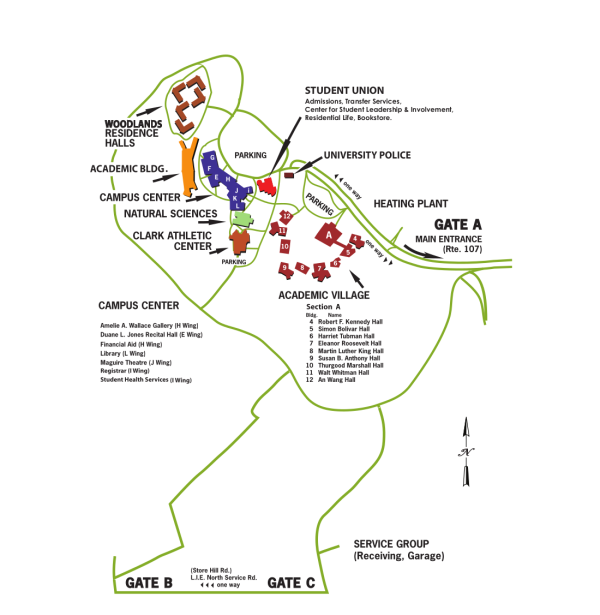
The University Police Building is located adjacent to the Student Union parking lot in the middle of campus. All community members can contact the University Police in person at the building or by landline phone at 516-876-3333, 516-628-5555 or extension 3333 from any campus phone, or by utilizing any of the 38 emergency phones located throughout the campus.