


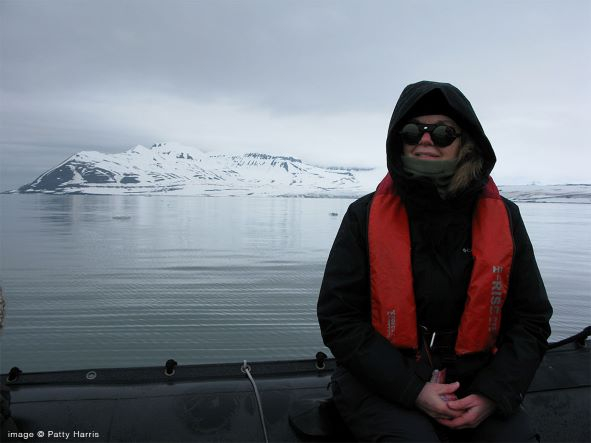
When Associate Professor of Visual Arts Patty Harris boarded a 180-foot expedition vessel in July 2025, she stepped into a world few ever see. For 16 days, she experienced an icy wilderness, drifting glaciers, and landscapes undergoing rapid change.
She traveled after having been selected for the highly competitive Arctic Circle Residency, an annual expeditionary residency program that explores the high-Arctic Svalbard Archipelago and Arctic Ocean. Harris spent more than two weeks exploring the remote Norwegian territory with 29 other artists, scientists, architects, and educators from around the world.
She returned to SUNY Old Westbury and shared her experience as the inaugural speaker in the OW STEAM colloquium series. Her presentation, sponsored by OW STEAM, drew students, faculty, and staff eager to glimpse the Arctic through an artist’s lens.
Turning a cabin into a camera
With a deep interest in alternative photographic processes, Harris found inspiration not only in the scenery but in the ship itself. Inside her small cabin, she transformed the space into a functioning camera obscura, blocking out all light except through a tiny opening.
What emerged was a projected reflection of the passing rocky, barren inlets and fjords – all multiplied by the cabin’s shallow architecture.
“I’m interested in working with an unusual perspective, where things are shifted,” she explained. Using her phone, Harris captured these fragmented, dreamlike reflections that she will expand into future projects.
A front-row seat to a changing planet
Each day, residents boarded zodiac boats to get closer to Svalbard’s glaciers. It was here that Harris witnessed both beauty and unsettling fragility.
“You’d be in the zodiac and hear a thundering noise off in the distance,” she told the audience. “some seconds later, a big chunk of glacier would fall into the water.”
Calving, as the phenomenon is known, is increasing as Arctic ice melts at unprecedented rates.
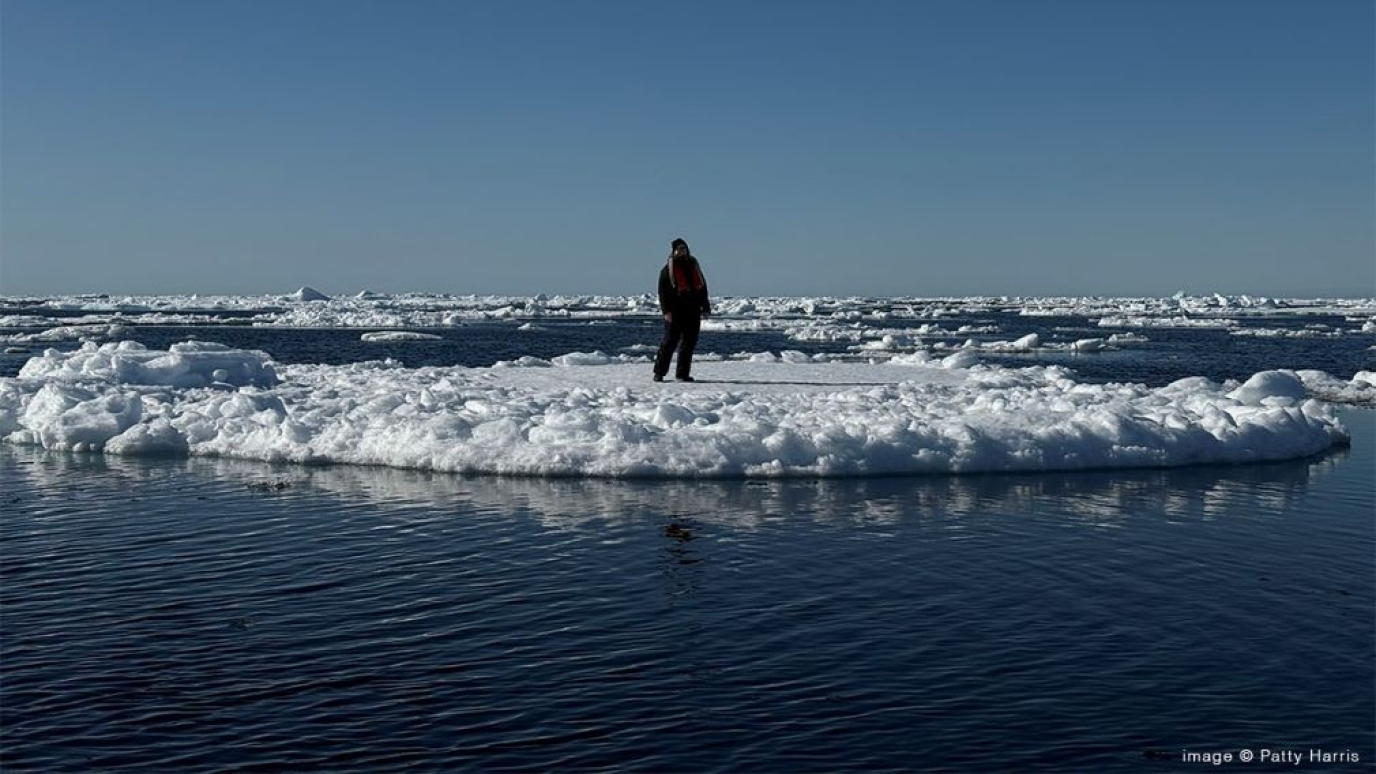
One photo from her trip shows Harris standing alone on a massive sheet of drifting ice.
“You can’t tell by looking at it, but that piece of ice is revolving,” she said, explaining that the affect led to her losing her sense of navigation. “Normal points of reference are moving. The feeling of a constantly shifting world is central to an experience of the Arctic wilderness. Bearing witness to this state of change is an inspiration for future work.”
Adventures on the ice
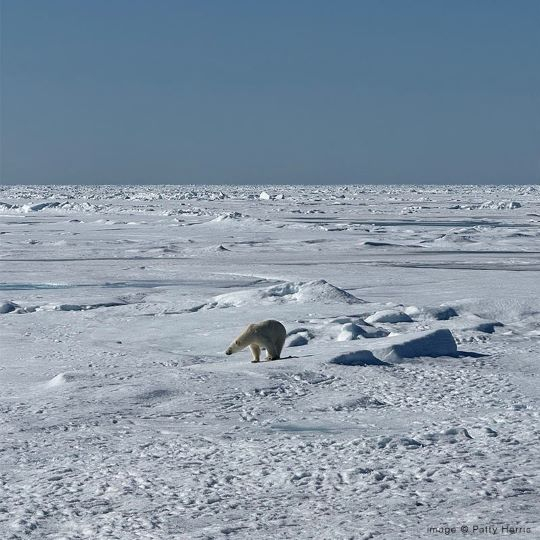
Svalbard’s remoteness offered more than silence and ice. Harris and her team encountered reindeer, seals, walruses and polar bears. One young male polar bear, healthy and alert, watched them from a distance before slipping into the water.
Of the walruses, she recalled, “About six of them suddenly jumped in the water and swam down to meet us.” The group regularly also passed seemingly well-preserved animal bones which served as haunting reminders of wildlife both thriving and lost.
Despite an experienced captain, the ship itself was not immune to the Arctic’s unpredictability. “We had the experience of getting stuck in the pack ice,” said Harris. “The captain told us later that there’s always something new to learn about the ice.”
Bringing the Arctic back to the classroom
For Harris, the residency wasn’t just a personal milestone as she now uses it as a teaching tool. She presented her Arctic photography to her Graphic Design I class, and asked her students to design logos for the Arctic Council, an international body focused on environmental sustainability in the region.
She hopes to integrate her experience into future courses as well.
“I hope students realize that there’s a lot of different ways they can be creative,” Harris said. “I hope they become inspired to be interested in the world and their place in it, and what they can bring to the communities they are a part of.”
As Harris continues processing her photographs and memories, one theme resonates: rapid change.
“The message I would like to get across is the incredible rate of change up in the Arctic,” she said. “It’s a reality we’re not fully aware of.”
Her residency may be over, but Harris’ telling of the Arctic’s story through her art has just begun.