


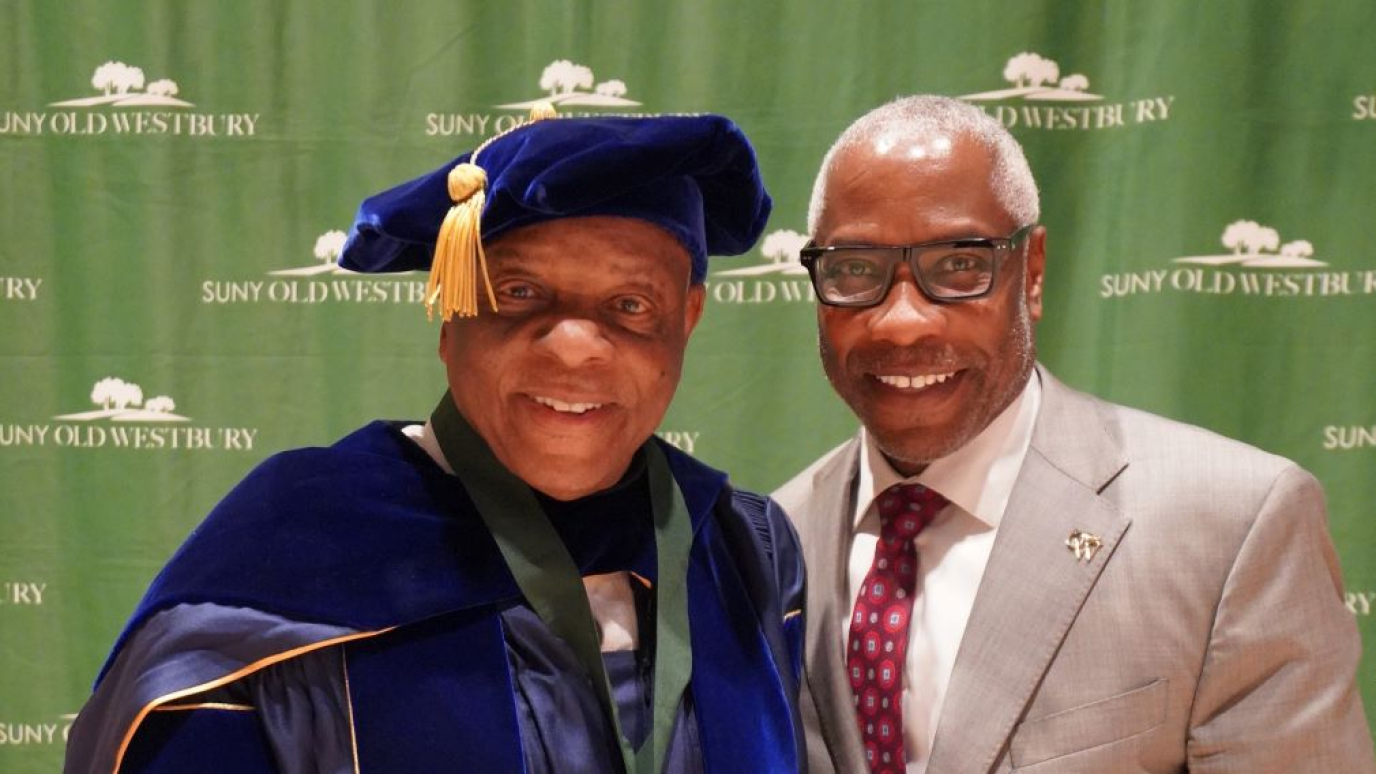
Insightful commentary and applause for a life and career dedicated to transformational teaching, scholarship and activism were the focus as the State University of New York at Old Westbury honored Dr. Molefi Kete Asante with its inaugural Presidential Medal.
A professor in the Department of Africology at Temple University, the president of the Molefi Kete Asante Institute for Afrocentric Studies, and most recently named a fellow of the African Academy of Sciences, Asante is known around the world for his work in developing the philosophical framework of Afrocentricity as a lens to reestablish the cultural identity and heritage of African Americans who have historically faced disconnection from their roots due to systemic oppression faced across history.
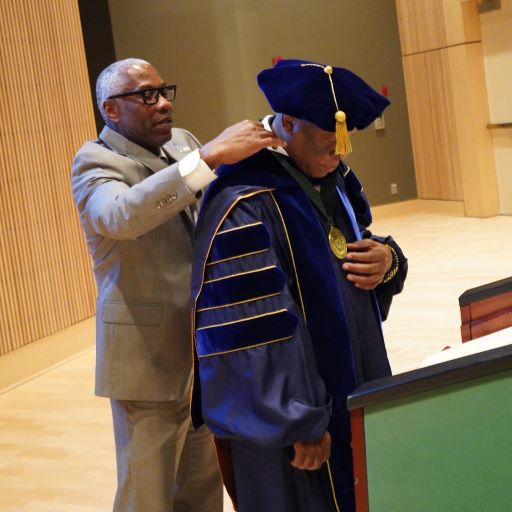
In the Duane L. Jones Recital Hall on April 29, 2026, before an audience of students, faculty, staff and friends of the campus, Asante was awarded the newly minted SUNY Old Westbury Presidential Medal to recognize his vision and leadership that both epitomize the campus’ mission and vision as an institution dedicated to excellence, equity and service.
“Molefi Kete Asante has spent a lifetime breaking new ground by challenging our understanding of national and global history and society and in the process changing the world for the better,” said SUNY Old Westbury President Timothy E. Sams, who studied under Asante while earning his Ph.D. in African American Studies at Temple University. “Without individuals like Dr. Asante building the bedrock of our understanding of social justice, institutions like ours would simply not be possible.”
In a presentation titled “AI and the African Vision,” Asante provided insights from his own and African history to frame the good and harm that might come from the fast-moving developments around artificial intelligence.
What I’ve discovered that is extremely important is that the basic characteristic for us as human beings is to figure out how it is possible to maintain an infrastructure that is so called artificial intelligence, at the same time that we are applying ethics to the situation."
-- Dr. Molefi Kete Asante
Juxtaposing the current state of AI to his experience training young woman named Freedom to become a journalist in early 1980s Zimbabwe, Asante discussed the need to recognize the circumstances being faced and the need to act.
“The conditions that confronted them at that time were conditions that would have led to disaster,” he said. “Like Freedom then, our youth will be met with unsupervised interchange through our created instruments, instruments that we have created with our own logic but that is often divorced from ancestral intelligence.”
He noted that, like electricity and the internet before it, artificial intelligence has become part of the world’s infrastructure. To succeed with that infrastructure and further efforts to create a more just, equitable world, however, he called for adherence to what is known in African history as “my face, my artistic tea.”
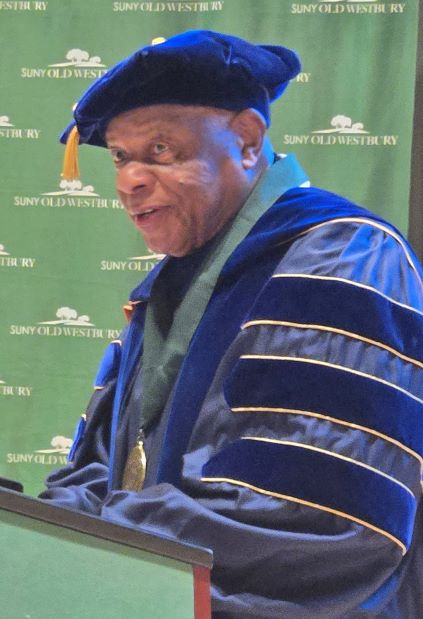
“My key concerns are cultural and phenotype bias and the use of biological race as elements for creating many of these tools,” Molefi said, also pointing out the increasing prevalence of misinformation and the concentration of power among the wealthy. “If you want to stay relevant in an AI-driven world, you need to build a mix of practical and durable skills. And what I’ve discovered that is extremely important is that the basic characteristic for us as human beings is to figure out how it is possible to maintain an infrastructure that is so called artificial intelligence, at the same time that we are applying ethics to the situation. “
The creator of the first Black Studies program in the United States at Temple University, Asante is a noted author with more than 500 articles and 104 books across his more than 50-year career, including “African American History,” one of the only high school textbooks written by an American scholar that provides students with an African-centered perspective on history. Asante was also the founding editor of the Journal of Black Studies, a peer-reviewed publication published for the last half of a century that serves as a leading source for dynamic, innovative, and creative research on the Black experience.
“Few people have gone as far as you have in pursuit of justice and freedom for all human beings, but with special interest in the African voice,” said Sams in closing the ceremony. ”And few people have been as effective as elevating that voice. We are tremendously appreciative of your contribution, not only to the academy, but to the overall human pursuit of freedom.”
The inaugural Presidential Medal investiture was held as part of the campus’ celebration of its 60th Anniversary. Since being chartered in 1965, SUNY Old Westbury has become today among the most diverse campuses in America recognized for its success in enhancing the social mobility of its students. Through its nearly 70 undergraduate and graduate programs, Old Westbury prepares students for the careers and lives they see for themselves while cultivating critical thinking, empathy, creativity and intercultural understanding, alongside a passion for learning and a commitment to building a more just and sustainable world.