

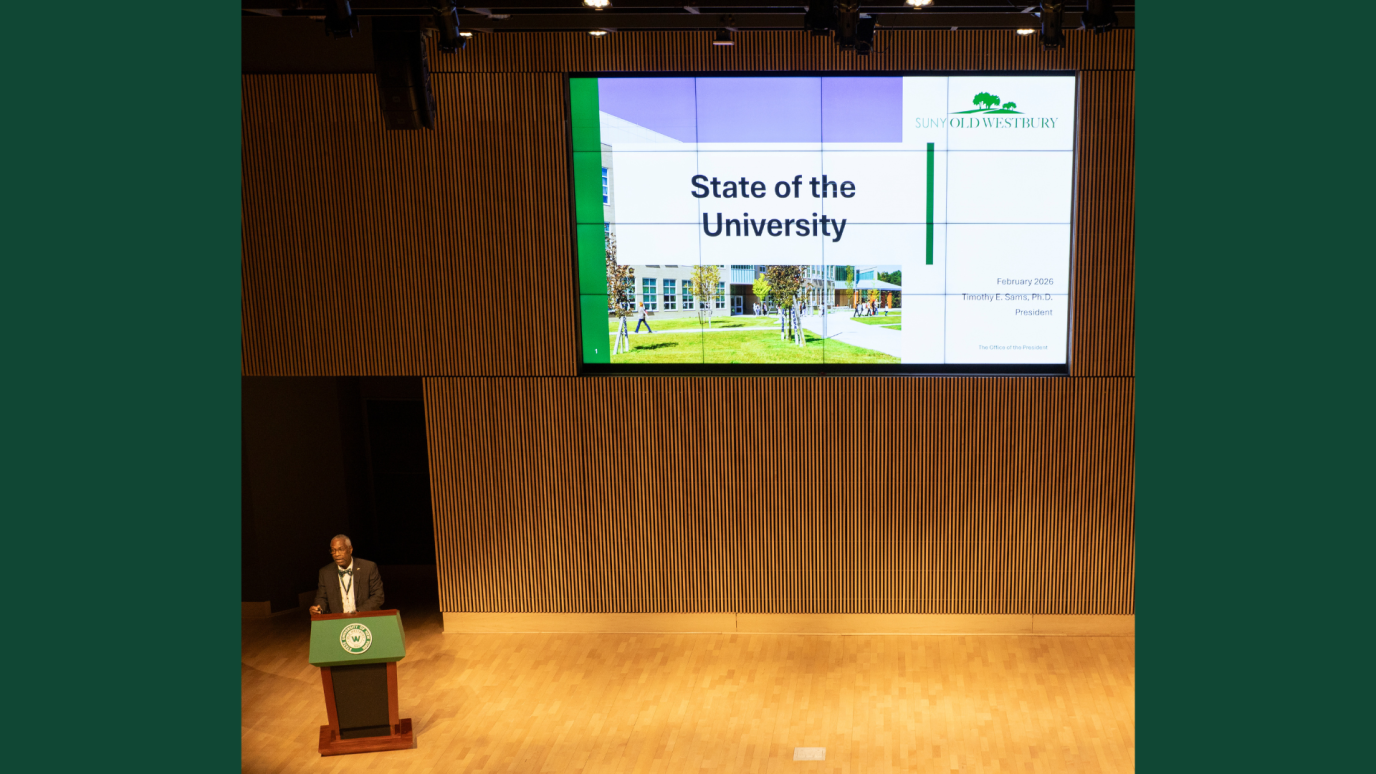
SUNY Old Westbury President Timothy Sams delivered an energetic and forward‑looking 2026 State of the University Address, outlining ambitious plans for artificial intelligence integration, major student‑success initiatives, and a slate of campus achievements that mark a period of transformation for the institution.
A future built on ethical and universal AI literacy
Central in his message was the campus’ commitment to preparing students for the accelerating artificial intelligence era that is fast becoming a defining priority.
“We are in the midst of a technological revolution around big data and AI,” he said. “We will not be a university that is left behind.
He praised the work of the University’s AI Task Force, which returned its comprehensive plan earlier than expected. “What they’ve come back with is a vision… that every one of our students would receive AI literacy by the time they graduate,” he announced, describing the initiative as the University’s “moon shot” to achieve ethical, inclusive AI education.
The centerpiece of the campus’ new plan will be a focus on “AI2EI,” whereby the campus prepares and operates using the best practices and tools artificial intelligence affords while also focusing on, in Sams’ words, “the essential question of how Al can be used ethically and sustainably to advance the cause of social justice in our region, our nation, and around the world."
As a focal point of this effort, SUNY Old Westbury will launch the Institute for AI & Ethical Innovation to push forward the campus’ efforts related to the influence of AI on instruction, operations, and more. The plan also calls for an AI microcredential to be earned by every student prior to graduation, discipline‑specific applications of AI in every major, and experiential or research‑based AI learning. It is structured to ensure students understand not only the technology but “the social and ethical use of AI” and how it will shape their future careers and our nation.
Sams promised that leadership appointments to guide this campus‑wide AI effort will be announced soon.
Gaining strength through enrollment growth
Even as the Northeast faces a demographic “enrollment cliff,” SUNY Old Westbury continues to perform strongly, said Sams.
“We are 1.1% over where we were at this time last year in terms of applications,” Sams said, calling the progress “something we are very proud of.”
Recruitment gains are tied to targeted digital campaigns, enhanced transfer orientation, global outreach efforts, and renewed partnerships with Long Island schools.
However, the president stressed urgency around developing new academic programs to sustain momentum: “We need at least 500 more students to reach our optimum,” he said. “This will require a more dynamic curriculum and new, market‑responsive degree offerings.”
He also noted that a top institutional priority going forward will be improved retention and graduation rates.
“We have lost traction in recent years in terms of retention, as well as in terms of graduation rates,” he said. “We have to be able to guarantee our students that if they do their job and we do our job, they will graduate.”
To meet that challenge, SUNY Old Westbury has implemented and will implement several high‑impact initiatives:
- ACE Program: Launched in fall 2025, the ACE program promises structured, personalized support through graduation. “Our goal is to support [these students] all the way to graduation,” Sams said, with another 150 students expected to join next fall.
- Professional Academic Advising: Beginning in fall 2026, “our faculty will no longer have to advise,” he stated. The university will shift to professional advisors so faculty can deepen mentorship and undergraduate research engagement.
- SUNY Academic Momentum Initiative: The objective of the Old Westbury component of this system-wide campaign is to improve retention of first year students to 80 percent, increase gateway course completion, and maintain the campus’ already high level of FAFSA completions. Sams made clear its importance, noting these benchmarks are essential to moving students “in, through, and out of our university.”
Along with reviewing the array of opportunities that lie ahead for the campus, Sams also provided an update on recent accomplishments and areas of progress, including:
Heightened faculty productivity and external recognition: “Our faculty have been quite productive over the past year,” he said, pointing to across‑the‑board increases in research output, including a 19% rise in peer‑reviewed publications. He noted that University is moving very close to achieving the threshold of $5 million in annual research funding, one of the required benchmarks for achieving the campus’ goal of earning a Carnegie R2 classification.
Enhanced Student Services: Sams praised the University’s student‑facing divisions for their record‑setting support. The CARE Team, counseling services, medical care, and disability services were all highlighted for their high volumes and strong reputations.
Capital growth and infrastructure modernization: The president reported on the continued construction on the $200 million Natural Sciences Building project, which includes new lab facilities, expanded instructional space, and a geothermal system. Additional campus improvements include roadway upgrades, technology enhancements, and the arrival of a much‑requested new campus shuttle vehicle.
A mission anchored in campus values
With all the progress underway and the opportunities that lie ahead, Sams closed by reflecting on SUNY Old Westbury’s 60th anniversary and reaffirmed his and the University’s commitment to the campus’ identity and long‑standing mission.
“Over these past 60 years, we have stayed the course, working to ensure students experience a close education that instills in them a belief in themselves and the improvements they can make in their lives and their communities,” he said. “We have not changed, and we won’t as long as I serve as your President."