


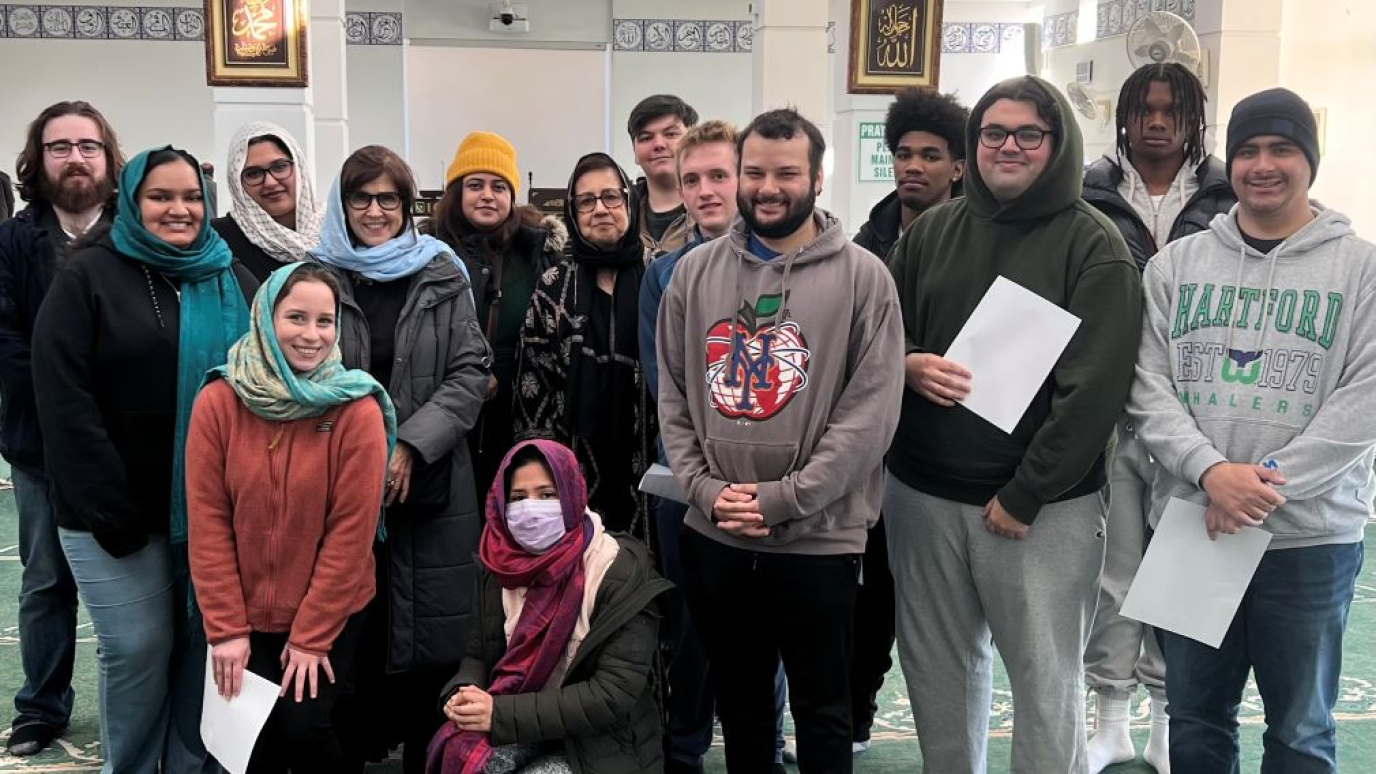
Students from SUNY Old Westbury’s “Crescent and Cross” and “Islamic Cultures” courses visited the Islamic Center of Long Island recently for discussions with Dr. Isma Chaudhry, the first-ever female president of a mosque on Long Island.
The ICLI, located in Westbury, New York, was founded in 1984 as a small two-story house and was expanded from 1989-1991. The mosque consists of a prayer hall for men and women, instructional classrooms, a library and offices. It also serves as a space for community programs.
“The purpose of the visit is to give an experiential lesson to students who have been learning from books about history of religions,” said Alice Hunsberger, adjunct history professor who is teaching both classes this fall. “I believe in getting students outside of the classroom.”
Hunsberger has been taking her classes to visit the ICLI for 10 years as a means of providing an immersive teaching experience and promoting civic engagement.
“SUNY Old Westbury was founded to do several things – to open up people to the world and to other views, to see each other and to make students active citizens in the world,” she said. “My hope is that with a vivid experience like today, this would be strengthened.”
Students began the visit by adhering to the dress code of the mosque. Female students wore hijabs using scarves to cover their hair as a sign of modesty and all students removed their shoes as a sign of cleanliness and respect. For many students, this was their first time in a mosque.
“It was really cool to see the mosque and walk around,” said Killian Doherty ’26. “It was very different than going to a church or anything else I’ve done.”
Once in the prayer hall, they began identifying aspects of the space they learned about in class, including the qibla wall, the wall indicating the direction of prayer.
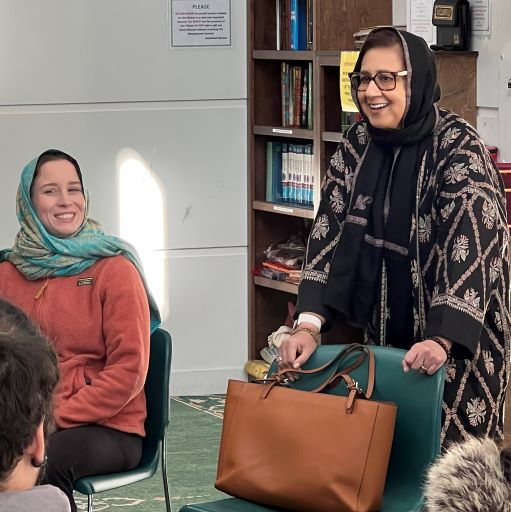
Chaudhry invited the students to sit on chairs in a circle in the hall, opening the floor to questions about Islam to help students better understand the religion and its practices. Chaudhry, who served as the president of the ICLI from 2015-2018 and is now a member of its board of trustees, said, “I always hope students are bold enough to ask questions. If there’s something different in your culture or whatever practice it is, just communicate; Just find out and find a nice way to talk to people.”
The discussions connected to class teachings with one student immediately noting the lack of idols and iconography in the prayer hall just as he had learned in class. The only form of art they saw were white and blue squares tiles of Arabic writing that lined the walls, which Chaudhry confirmed to be the 99 attributes, or names, of Allah according to the Islamic religion.
The conversations sparked interest among students as they asked questions about Islamic wardrobe and made connections to other religions, including questions regarding the code of Jewish law and its relationship to Islam's purified laws.
During the discussions, congregants entered and exited the hall and engaged in prayer. Students watched them bow and prostrate, which is a prayer ritual in which the individual descends to their knees, bends down to the ground and leans their forehead to the ground.
Students also witnessed a call to prayer led by an imam at the conclusion of their discussion.
“An imam basically is the individual who would lead the prayer, who will make sure that the calls to prayer are called at the proper times and of course has good knowledge of the Quran and the Sunnah,” Chaudhry explained.
As the students exited the prayer hall, they were able to see an ablution room, a cleansing area used by congregants prior to prayer.
“To feel a religious service inside a sacred space like a mosque is a very moving experience students tell me,” Hunsberger said.
Environmental studies student Rachel Hayes ’27, noted that the mosque had a peaceful atmosphere. “It was just a nice community. They were very welcoming.”