


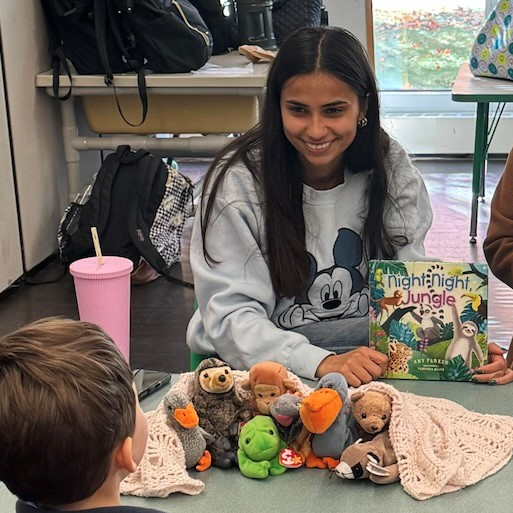
Along with nestling in for a night in the jungle on the pages of the award-winning children’s book “Night Night, Jungle,” a collection of jaguars, monkeys, sloths and more settled in with the pre-school aged children of SUNY Old Westbury’s on-campus child care center recently thanks to one of six projects featured during a visit by students from the campus’ School of Education.
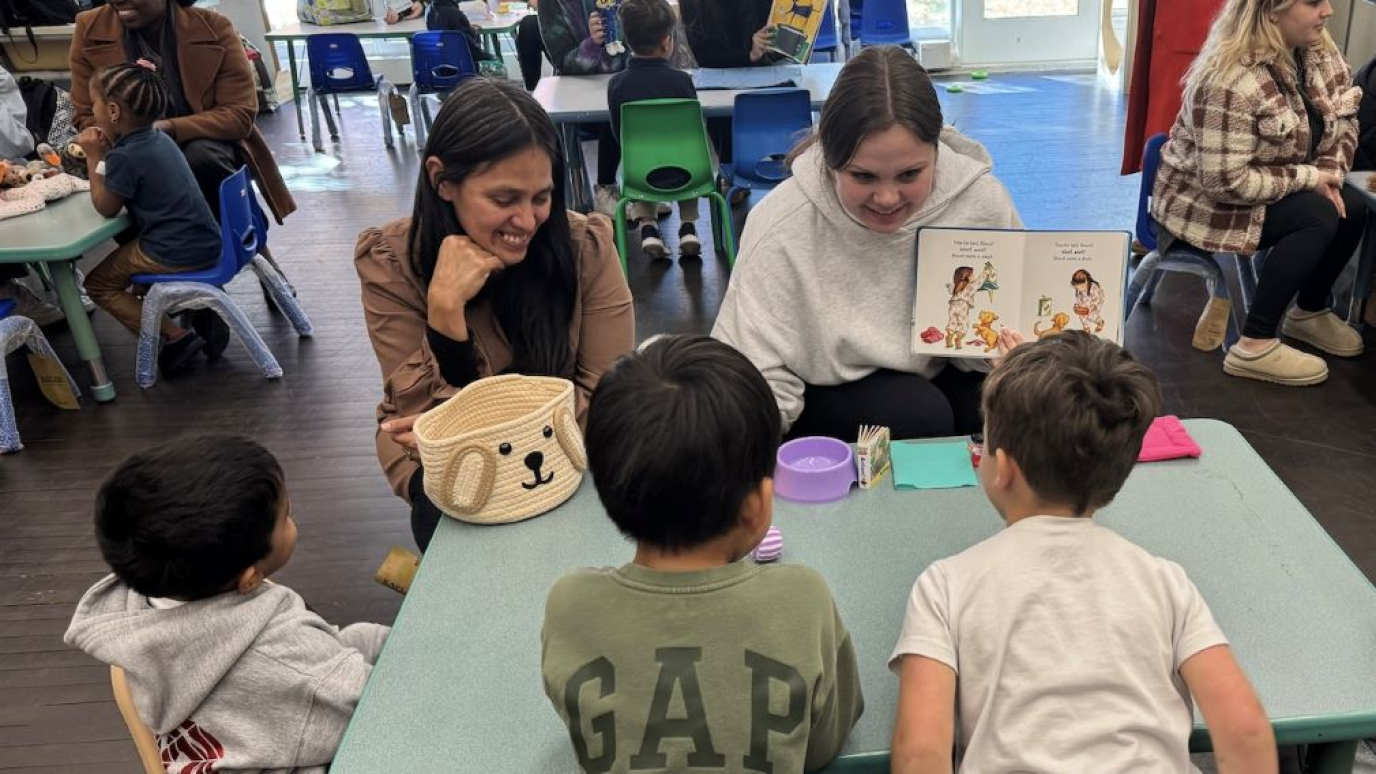
The visit to the Academic Explorers program occurred as part of Assistant Professor Shalinie Sarju’s Language Development and Instruction for Diverse Learners class, where students were assigned to create “storybook baskets” based on children’s literature. Storybook baskets are visual, manipulable versions of storybooks that enable young students to interact as a story is told.
“We focus on how language and literacy are intertwined and developed from the very early stages all the way up to high school,” said Sarju, a faculty member in the Exceptional Education & Learning Department, of the language development and literacy focus of the course.
Each of her students was instructed to select a book to “bring to life,” which was a teaching experience in and of itself, according to Melissa Sinon ‘26, a senior pursuing a Bachelor of Science in the Students with Disabilities. When picking a book for the project, Sinon read different books at a thrift store to find the right one. She analyzed the text on the page, the supporting images and the characters in the story to ensure it was appropriate for the preschool children.
“I definitely want to be a very inclusive, mindful teacher,” Sinon said. “I think this project really helped me to find books that use inclusive language because I didn't want to use any book that will alienate anyone for any reason.”
Sinon landed on “Night Night, Jungle” by Amy Parker, which follows the story of jungle animals going to sleep as it becomes nighttime. She then picked items to fill in the storybook basket, including physical representations of the characters, places and items referenced in the book. Sinon used stuffed animals, also purchased at a thrift store, to represent the jungle animals and a knit blanket to represent the bed.
“I work in a preschool,” Sinon explained. “I know kids love to play with stuffed animals. They gravitate towards things that are soft and fuzzy and furry.”
After presenting their storybook baskets to their own class, the School of Education students voted on six projects to bring to Academic Explorers, one of them being Sinon’s. Sinon worked with a classmate to tell the story to the preschool children. She said the students were engaged with the story as they helped tuck the stuffed animals into bed.
“There was one little boy that was so excited,” Sinon said. “He was creating his own story from the story and continuing on.”
And, when the story ended with the animals going to bed, he would wake them up and start a new day, she described.
Sarju was excited to see the students supporting the development of literacy skills with the Academic Explorers preschool students using a project created in class.
“It was an actual classroom with wonderful little students who were very engaged,” Sarju said. “I think it’s a really valuable, real-world hands-on experience in a structured and safe environment right on our campus. We vetted everything ahead of time to make sure it's as beneficial as possible for the little ones as well as the teacher candidates.”
The storybook baskets give preschoolers a way to experience storytelling in addition to looking at and listening to a book. The goal of the project is to teach prospective teachers about the techniques they can use to help young students develop their language and literacy, which Sarju's students are assigned to discuss in a paper about the project.
In addition to learning about the creation and use of storybook baskets as a lesson, Sinon also reflected on her learning experience in the Academic Explorers’ classroom. She said she learned aspects of becoming a leader in a classroom and how to tell stories in an engaging manner while maintaining a pace that will retain students’ attention. She was able to analyze how she taught her lesson with a small group and consider how she would approach the lesson with a bigger group if she had her own classroom.
Sarju had assigned the project in a prior semester, but those Old Westbury students only shared their work amongst themselves making this semester’s experience the first time the future teachers engaged with children through their projects.
“I loved seeing the students sort of come alive with the little ones,” Sarju said. “I saw them work through their hesitancy and ultimately really enjoy presenting their books and interacting with the students.”
Sinon believes access to the on-campus preschool is both a valuable tool and mutually beneficial for she and her fellow teacher-candidates and for the children.
“I think even if all the classes could get to just observe early education like that, I think it would be super beneficial.”